I took a gamble again with Assignment Three shooting it overseas, but on this occasion, I know I can re shoot in the UK if I have to. The themes will be the same, but different images. Hopefully it won't come to that! I'm just pleased that I had another opportunity to use street/travel photography themes for an assignment.
I decided on this occasion to submit five images. Using a tightly edited and visually consistent approach worked well for Assignment Two, so I applied the same methodology. Adding more than five images would not have added extra information to the story; it already said what I wanted to say, and adding more (as I found out) risked introducing images that were not visually consistent.
Overall, my criticism of this presentation is whether the narrative is actually about the speed of the passage of time, or the volume of work I have to do. Hopefully, the relationship between the two elements and the fact that they have an adverse impact on each other comes through.
It was hard for me to try to shoot deliberately blurred scenes; I usually aim for absolute precision. Although actually, apart from Image 1, which was deliberate, and 2 where I tried to be a bit sharper, the others are a bit fuzzy by happy accident.
The images I like the most are 1, 3 and 5. I really like image 1 from Tokyo: it conveys the concept of a flood of stuff (represented by the people on the crossing) coming towards me (the daily tidal wave) and the street photography elements of the matching jumpers on the girls is an added bonus. This was shot handheld at the slowest shutter speed I dared without blurring the background - 1/15s. I think I managed to get sufficient softness without losing outlines. The inclusion of the "stop hand" in the top left corner, works well as the "voice of reason" telling me to slow down, even though it's impossible. And of course Starbucks in the background: coffee to start the day! Image 3 from Osaka is a street photography "moment" shot through the back of the machine, creating the illusion of multiplying tasks (represented by the reflection of the bears) and the added twist of the man grabbing a toy instead of the claw. Image 5 from the snow monkey park in Jigokudani Yaen-Koen on Christmas Day was an accident. I didn't know I'd taken it until that evening when I was editing my 1000 shots from that day and I found it. It was taken with a shutter speed of 1/160s so that tells you how fast they shake their heads! I was trying at the time to create a cute monkey bathing picture, and didn't mean to take a demonic head-shaking "Exorcist" monkey. I'm glad I didn't realise it was there on the day, as I would probably have deleted it, thinking it was too blurred.
The image I don't like is Image 4. This was taken in Miyaji (an island near Hiroshima) on New Year's Eve at the Chinkasai Fire Festival. It was very crowded, raining and moving very fast. I took a lot of shots trying to get the fire action with faces coming towards me (rather than backs) - they all failed - the framing was hard with everything moving so quickly. This image is in fact a crop (hence it is a bit grainier than the others).
Image 2 is ok; it was an easy shot being indoors and not moving (although I had had a few drinks when I took it). This is in fact the toilet door of the bar I was in and it immediately looked like the boxes on my Outlook calendar at work on week view when I saw it. Later I noticed the two toilet symbols, which made me laugh, as that is also a problem (as in finding time)... the gap giving me time for one lunch break during the week was an added bonus.
In terms of the Assessment Criteria, here are my thoughts:
Demonstration of technical and visual skills
If I'm honest, I don't think technically I pushed myself or tried anything new really. I was operating within my street photography comfort zone (much easier in Asia than in UK), and didn't attempt anything tricky. Technically the hardest shot was Image 4 because of the movement, weather and light, and having to keep up with the festival participants. I had an opportunity to try something more creative with Image 1 (i.e. use a tripod and try to get people ghosting or maybe use a zoom burst on one person), but because I already had an image I liked, which had sufficient (very slight) blur I decided to stick with that one. I was also under time pressure by then.
Quality of outcome
Having made the claim that I was inspired recently by two contemporary images that made the most of a monochrome, blurred technique, I don't like very much what I made. The pictures are very dark and my interpretation of the subject matter is very dark; this is quite a contrast from my what is (now) usual colourful and comical images. I'm pleased though that I managed to put together something that said what I wanted it to say, but I don't feel that this is representative of my own style. I'm not sure I have a style yet, but I don't think it's going to be this. In terms of whether it hangs together as a series, the images are connected by theme and visual consistency, but not in terms of a linkage effect between each one, as I had achieved with Assignment Two. This series needs the text to make it hang together.
Demonstration of creativity
I never know how to answer this part; yes I've made something - I've created something from nothing and I've tried a different way of presentation. It's unlikely to be very original - I'm sure the Shibuya Crossing has been photographed a million times already. I suppose from the point of view that I have presented images in a different way to normal, they could be considered creative, but on retrospect, I do prefer colour street photography. I think all the images work better individually in colour, but they sit better together as a series in black and white. And of course I wanted to make them seem sinister, which I think the black and white helps with. I chose the black background and white writing to the presentation format to enhance the concept of this mysterious force that controls my life. All in all, the interpretation (metaphorical) is probably more creative than the photography itself.
Context
My research for this assignment continued with my general and on-going street photography work (see other posts under the "Street Photography" tag) and the two photographers I mentioned. I am looking more and more now at contemporary photographers who have made the leap that I am trying to make, i.e. to find my own style. By looking at contemporary photographers who were recently at my stage of the journey (rather than some of the older classics e.g. Bresson), and who perhaps a few years ago were where I am now, makes the end goal seem more attainable. I did however follow my tutor's advice, which was to try to get deeper into one subject.
Overall
Overall I am pleased to have done this work, but I don't think introspection is the way forward for me. I am more interested in observing the world around me than looking within.
Waiting for Summer

Showing posts with label Assignment Two. Show all posts
Showing posts with label Assignment Two. Show all posts
Sunday, 8 February 2015

Sunday, 25 January 2015
Dana Popa: Not Natasha
As part of my feedback for Assignment Two, my tutor recommended I look at Dana Popa's "Not Natasha" series as an example of getting deeper into one subject.
My first reactions looking through the images were about shock, horror, how appalling that situation is (beyond appalling), but also how sensitive the images are. Not Natasha is a series about sex trafficking in Eastern Europe and the impact it has on the victim's lives and their families. More information about the series is available from lens culture.
Looking through the images you see evidence of how young the girls are, how unhappy they are, the damage they are suffering (scars from self-harming), how cheap their lives are, how they have been objectified, abused, tortured, how their families are ripped apart, their lives devastated by the kidnappings, some are even betrayed by their families (one girl was sold by her fiance) and to be frank, it's sickening. Sickening that human beings can be so depraved and vile to other human beings. In some images you see the victims, in others you see their environment, and evidence of their existence (traces) or their situations. And although these images have been sympathetically shot, there is no doubt that Popa is engaged and on some level also feeling their pain, I find them chilling. It is a horror story equal to that of conflict photography.
In terms of photographer's engagement - it's clear that she had researched her subject, and spent a lot of time with the girls getting to know them and their story, traveling to do so. She must have also taken many risks with her own safety to do so. She spoke with seventeen different women to gain an insight into their lives and in doing so must have had been able to show a protective, sympathetic and supportive approach. To get people to open up on a subject like this must be very challenging emotionally, for both subject and photographer. I wonder if Popa needed emotional support herself to be able to produce a body of work that is subjective, but also stands up as a solid documentary.
One thing I noticed, which contradicts the advice I have been given about putting a series together is the format of the photographs. I have been told repeatedly that a series should be visually consistent, which this is in tone/colour/subject/emotion - but not in format. She has mixed horizontal/vertical rectangles with squares, some with a white border, some with no border, some with text, some without text. What does this mean? It's obviously deliberate. Is it a commentary on complexity?
How does this relate to my work? Why was this recommended to me? The recommendation came as a result of my work for Assignment Two which was street/travel photography in theme. My approach to street photography is not a documentary/reportage approach like this, but a spontaneous and impulsive exploration of random events looking for twists and irony in every day life. I like to combine it with the travel element as this gives me a fresh and curious perspective; I notice more when I'm abroad than I do at home. It's new, different and exciting, and to be honest, I get an adrenaline surge from doing it. Even planning the trips gives me a rush.
So at the moment, I can only relate to this work coming from a position of both deep sympathy and appreciation of the amazing photographic skill and engagement. I have thought a lot about where my photography is going over the past couple of years, and I'm happy with the direction it's heading at the moment. I'm having a lot of fun with it, and for me, right now, that's what I want. After a 50 hour working week, 15 hours of commuting, squeezing in friends, family and degree work (see Assignment Three for that context!) - all nice problems to have, but I do need to let off steam (not make more steam). I realise that as this degree progresses, I may need to dig a lot deeper than I am at present, but I don't think I could take on something as committed and engaging as this right now. BUT as time goes on, I'm sure I will, particularly once I have retired or maybe even once I've found something that I desperately want to document. I can see myself in the future, once I have more time, making documentaries/reportage articles about animal conservation and protection issues. That's why I'm dabbling in Wildlife Photography as well!
I have also been thinking about documenting journeys along barriers, e.g. Israel/West Bank and making comparisons between people's lives.
Websites:
My first reactions looking through the images were about shock, horror, how appalling that situation is (beyond appalling), but also how sensitive the images are. Not Natasha is a series about sex trafficking in Eastern Europe and the impact it has on the victim's lives and their families. More information about the series is available from lens culture.
Looking through the images you see evidence of how young the girls are, how unhappy they are, the damage they are suffering (scars from self-harming), how cheap their lives are, how they have been objectified, abused, tortured, how their families are ripped apart, their lives devastated by the kidnappings, some are even betrayed by their families (one girl was sold by her fiance) and to be frank, it's sickening. Sickening that human beings can be so depraved and vile to other human beings. In some images you see the victims, in others you see their environment, and evidence of their existence (traces) or their situations. And although these images have been sympathetically shot, there is no doubt that Popa is engaged and on some level also feeling their pain, I find them chilling. It is a horror story equal to that of conflict photography.
In terms of photographer's engagement - it's clear that she had researched her subject, and spent a lot of time with the girls getting to know them and their story, traveling to do so. She must have also taken many risks with her own safety to do so. She spoke with seventeen different women to gain an insight into their lives and in doing so must have had been able to show a protective, sympathetic and supportive approach. To get people to open up on a subject like this must be very challenging emotionally, for both subject and photographer. I wonder if Popa needed emotional support herself to be able to produce a body of work that is subjective, but also stands up as a solid documentary.
One thing I noticed, which contradicts the advice I have been given about putting a series together is the format of the photographs. I have been told repeatedly that a series should be visually consistent, which this is in tone/colour/subject/emotion - but not in format. She has mixed horizontal/vertical rectangles with squares, some with a white border, some with no border, some with text, some without text. What does this mean? It's obviously deliberate. Is it a commentary on complexity?
How does this relate to my work? Why was this recommended to me? The recommendation came as a result of my work for Assignment Two which was street/travel photography in theme. My approach to street photography is not a documentary/reportage approach like this, but a spontaneous and impulsive exploration of random events looking for twists and irony in every day life. I like to combine it with the travel element as this gives me a fresh and curious perspective; I notice more when I'm abroad than I do at home. It's new, different and exciting, and to be honest, I get an adrenaline surge from doing it. Even planning the trips gives me a rush.
So at the moment, I can only relate to this work coming from a position of both deep sympathy and appreciation of the amazing photographic skill and engagement. I have thought a lot about where my photography is going over the past couple of years, and I'm happy with the direction it's heading at the moment. I'm having a lot of fun with it, and for me, right now, that's what I want. After a 50 hour working week, 15 hours of commuting, squeezing in friends, family and degree work (see Assignment Three for that context!) - all nice problems to have, but I do need to let off steam (not make more steam). I realise that as this degree progresses, I may need to dig a lot deeper than I am at present, but I don't think I could take on something as committed and engaging as this right now. BUT as time goes on, I'm sure I will, particularly once I have retired or maybe even once I've found something that I desperately want to document. I can see myself in the future, once I have more time, making documentaries/reportage articles about animal conservation and protection issues. That's why I'm dabbling in Wildlife Photography as well!
I have also been thinking about documenting journeys along barriers, e.g. Israel/West Bank and making comparisons between people's lives.
Websites:
- not Natasha by Dana Popa available from http://www.danapopa.com/gallery.php?ProjectID=218/photos/gallery/not_natasha_for_the_website_32-2.jpg [accessed 25 January 2015]
- not Natasha in lensculture magazine available from https://www.lensculture.com/articles/dana-popa-not-natasha [accessed 25 January 2015]

Saturday, 20 December 2014
Feedback and response to Assignment Two: Photographing the unseen - Wonder
Fantastic and encouraging feedback to Assignment Two from my tutor :)
I had fulfilled the brief and produced a tightly edited set that illustrated various conflicting interpretations of the concept of "wonder" in street photography style, with a recommendation for future work to explore the idea of focusing on one aspect of an idea and pushing deeper within the same idea, rather than laterally around the idea (I will try to do this for Assignment Three). My tutor recommended I research Dana Popa's "Not Natasha" series for a deep and personal insight into trafficking to get an idea of researching deeper into a theme, which I will in preparation for Assignment Three. She mentioned the risks of choosing a travel theme for an assignment but this had been a consistent approach. I will however be attempting this again in Japan for Assignment Three?
From a technical perspective, the feedback I received was that the images are strong, with colour and depth of saturation making them stand out. The focus is good and detail unusual for this stage of my development in street photography, with compelling compositions and the impression of being close to the communities I photographed. The tight editing had worked well and something to remember and keep up for future assignments.
To be honest, this is better feedback than I could have hoped for!
The only picture my tutor did query was Picture 6 - the dog and the shadow:

With this photo, I was trying to achieve a sense of mystery. While I was shooting it I had held the position for about 15mins over the real dog - I was practicing exposing for highlights against shadows, and was waiting for something interesting to happen while watching the shadows change. Finally a second dog came into view, but of course all you can see of the second dog is its shadow, which at first is confusing as it looks like the real dog has its shadow in the wrong place. But, at the time, when this great dog-shape came into view through the view finder, it actually felt quite sinister - it completely changed the light for one thing, but it also felt like the shadow dog was creeping past the sleeping dog. When I then put together my series and paired it backwards with the policeman looking alarmed and forwards with the child hiding behind bars, I was trying to get a sense of a frightening aspect of wonder across. I do have some other mystery shots I could substitute - but I felt that this one worked the best in terms of the peeling onions and transition from positive to negative concept of wonder.
Finally, to explore street photography further, she recommended researching further:
I had fulfilled the brief and produced a tightly edited set that illustrated various conflicting interpretations of the concept of "wonder" in street photography style, with a recommendation for future work to explore the idea of focusing on one aspect of an idea and pushing deeper within the same idea, rather than laterally around the idea (I will try to do this for Assignment Three). My tutor recommended I research Dana Popa's "Not Natasha" series for a deep and personal insight into trafficking to get an idea of researching deeper into a theme, which I will in preparation for Assignment Three. She mentioned the risks of choosing a travel theme for an assignment but this had been a consistent approach. I will however be attempting this again in Japan for Assignment Three?
From a technical perspective, the feedback I received was that the images are strong, with colour and depth of saturation making them stand out. The focus is good and detail unusual for this stage of my development in street photography, with compelling compositions and the impression of being close to the communities I photographed. The tight editing had worked well and something to remember and keep up for future assignments.
To be honest, this is better feedback than I could have hoped for!
The only picture my tutor did query was Picture 6 - the dog and the shadow:
With this photo, I was trying to achieve a sense of mystery. While I was shooting it I had held the position for about 15mins over the real dog - I was practicing exposing for highlights against shadows, and was waiting for something interesting to happen while watching the shadows change. Finally a second dog came into view, but of course all you can see of the second dog is its shadow, which at first is confusing as it looks like the real dog has its shadow in the wrong place. But, at the time, when this great dog-shape came into view through the view finder, it actually felt quite sinister - it completely changed the light for one thing, but it also felt like the shadow dog was creeping past the sleeping dog. When I then put together my series and paired it backwards with the policeman looking alarmed and forwards with the child hiding behind bars, I was trying to get a sense of a frightening aspect of wonder across. I do have some other mystery shots I could substitute - but I felt that this one worked the best in terms of the peeling onions and transition from positive to negative concept of wonder.
Finally, to explore street photography further, she recommended researching further:
- Joel Sternfeld
- Stephen Shore
- Saul Leiter
- William Eggleston
- Helen Levitt.
Sunday, 23 November 2014
Assignment Two - Reflections
I took a gamble with Assignment Two in shooting it overseas knowing that I would not be able to go back and reshoot in the same location. My tutor warned me about this, however, as the direction I want my photography to progress with is exactly this blend of street/travel photography, I am going to have to learn to get it right on location. In fact, this is the kind of pressure that many commercial photographers and photojournalists are under each time they shoot, so for me this is a reality I will also have to live with and should therefore practice. And I will do it again and again, as this is what I want to improve on, and I have decided that I will try to shoot Assignment Three in Japan over Christmas in Street/Travel Photography style.
I think though, the gamble paid off. I have a series of 7 images that I believe fulfill the brief. The assignment specifically mentioned that the series must be visually consistent and tightly edited, and I think they are, or at least I tried to achieve that. The colours/tones are very similar: mostly cool with the exception of the orange in the sunrise picture which punctuates the start of the series. In addition, each photograph leads into the next: they are all visually connected with each other by colour/tone or also by an element within the frame:
Presenting these images for an assignment though was also an emotive decision. I had such an amazing time during that week with Maciej Dakowicz, that there was no way I was not going to use the images! But, I hope it works out as a complete assignment - the emotional stakes are quite high, so I will be disappointed if it's not a success!
In terms of the Assessment Criteria, here are my thoughts:
Demonstration of technical and visual skills
During that week in India, I found that my technical and visual skills progressed way beyond my expectations. I was so happy with the process that I booked another workshop in Myanmar in March again with Dakowicz as I wanted to take it further still. I learnt so much about exposure, composition, story telling, observing, and so on, and I think it is reflected in these images. I also became a lot braver about being closer to people when I took photographs. I also learnt from Dakowicz how to put a portfolio together - how images need to connect with each other, and this has also been demonstrated in this assignment.
Quality of outcome
I'm happy with the quality of outcome - of course I am - I've never produced anything like this standard of work before (hope that doesn't sound too immodest but I'm still on a high from the whole experience)! The images are all clear, correctly exposed, no noise etc. My only concern is with the text - should I have captioned the images or included more text? I think the approach I took is the right one, I do want the viewer to wonder what is going on and think about their own reaction of wonder, without too much guidance, but I'm not 100% certain that I should not have included more guidance text.
Demonstration of creativity
This is definitely my most creative piece of work yet and I believe that personal voice is now starting to show. The best thing though is that I have "found myself". I've realised that I can combine my two biggest passions in life: travel and photography, and that my photography now has some direction. In my Reflections to Assignment One, I mentioned that I felt that various strands of photography were emerging. That's all over now. This experience was so exciting that I cannot bring myself to photograph anything else at the moment, and certainly not every day urban scenes. I can't wait to be able to have another experience like this. I get an adrenalin rush from Street Photography anyway, and I think it's time now to just focus on that, and combine it with travel where I can.
I am aware though, that, although the way in which I've used these photos is original, on account of the assignment directions, but, overall, my images from Varanasi look similar to other photographs I've seen taken by other people, and of course they are inspired by the style of Dakowicz. They are original for me, but overall, I need to step up still in finding more a more unique perspective. These broadly look like many people's travel photographs, so I feel like I'm just on the first step of the ladder now. But, I am thrilled though that I've found my ladder! I think it might have always been there, and I have spent the past six months intensely focusing on Street Photography, but until now, I wasn't really ready to rule out other avenues. But I am now :)
Context
Research for this assignment was limited to the work directed by the course materials. I got a really good sense through the projects, exercises and research points of what photographing the unseen can mean, i.e. through gesture, traces, metaphoric illustration, so I hope that this has come through in this piece of work.
Overall
Overall I am extremely pleased (as you probably gathered....sorry....) with this work. I think where I may get some learning points / constructive feedback will be in how I put the series together - were the photos in the right order - does the onion layers idea come through? Have I really captured the concept of "wonder"? Is this too illustrative and not sufficiently metaphorical? And also whether I should have used more text/captions. I will be interested to see my tutor's response and whether the ambiguity I tried to achieve came through.
Websites:
I think though, the gamble paid off. I have a series of 7 images that I believe fulfill the brief. The assignment specifically mentioned that the series must be visually consistent and tightly edited, and I think they are, or at least I tried to achieve that. The colours/tones are very similar: mostly cool with the exception of the orange in the sunrise picture which punctuates the start of the series. In addition, each photograph leads into the next: they are all visually connected with each other by colour/tone or also by an element within the frame:
- In photos 1 & 2, both men are covering their faces
- Photo 3 provides the head and upper torso that is hidden from view in photo 2
- In Photo 3, the man is peering into the room in photo 4
- Photos 4 and 5 both have an activity taking place inside a rectangle - similar compositions
- Photo 5 the man is looking out of the frame slightly alarmed at the dog in photo 6
- In photo 7, the child is looking back at the dog (also looking alarmed).
Presenting these images for an assignment though was also an emotive decision. I had such an amazing time during that week with Maciej Dakowicz, that there was no way I was not going to use the images! But, I hope it works out as a complete assignment - the emotional stakes are quite high, so I will be disappointed if it's not a success!
In terms of the Assessment Criteria, here are my thoughts:
Demonstration of technical and visual skills
During that week in India, I found that my technical and visual skills progressed way beyond my expectations. I was so happy with the process that I booked another workshop in Myanmar in March again with Dakowicz as I wanted to take it further still. I learnt so much about exposure, composition, story telling, observing, and so on, and I think it is reflected in these images. I also became a lot braver about being closer to people when I took photographs. I also learnt from Dakowicz how to put a portfolio together - how images need to connect with each other, and this has also been demonstrated in this assignment.
Quality of outcome
I'm happy with the quality of outcome - of course I am - I've never produced anything like this standard of work before (hope that doesn't sound too immodest but I'm still on a high from the whole experience)! The images are all clear, correctly exposed, no noise etc. My only concern is with the text - should I have captioned the images or included more text? I think the approach I took is the right one, I do want the viewer to wonder what is going on and think about their own reaction of wonder, without too much guidance, but I'm not 100% certain that I should not have included more guidance text.
Demonstration of creativity
This is definitely my most creative piece of work yet and I believe that personal voice is now starting to show. The best thing though is that I have "found myself". I've realised that I can combine my two biggest passions in life: travel and photography, and that my photography now has some direction. In my Reflections to Assignment One, I mentioned that I felt that various strands of photography were emerging. That's all over now. This experience was so exciting that I cannot bring myself to photograph anything else at the moment, and certainly not every day urban scenes. I can't wait to be able to have another experience like this. I get an adrenalin rush from Street Photography anyway, and I think it's time now to just focus on that, and combine it with travel where I can.
I am aware though, that, although the way in which I've used these photos is original, on account of the assignment directions, but, overall, my images from Varanasi look similar to other photographs I've seen taken by other people, and of course they are inspired by the style of Dakowicz. They are original for me, but overall, I need to step up still in finding more a more unique perspective. These broadly look like many people's travel photographs, so I feel like I'm just on the first step of the ladder now. But, I am thrilled though that I've found my ladder! I think it might have always been there, and I have spent the past six months intensely focusing on Street Photography, but until now, I wasn't really ready to rule out other avenues. But I am now :)
Context
Research for this assignment was limited to the work directed by the course materials. I got a really good sense through the projects, exercises and research points of what photographing the unseen can mean, i.e. through gesture, traces, metaphoric illustration, so I hope that this has come through in this piece of work.
Overall
Overall I am extremely pleased (as you probably gathered....sorry....) with this work. I think where I may get some learning points / constructive feedback will be in how I put the series together - were the photos in the right order - does the onion layers idea come through? Have I really captured the concept of "wonder"? Is this too illustrative and not sufficiently metaphorical? And also whether I should have used more text/captions. I will be interested to see my tutor's response and whether the ambiguity I tried to achieve came through.
Websites:
- Maciej Dakowicz available from http://www.maciejdakowicz.com/ [accessed 23 November 2014]
Friday, 31 October 2014
Assignment Two - Photographing the unseen - Wonder
What does WONDER mean?
- to be filled with amazement, admiration and awe?
- to think or speculate?
- to doubt?
 |
| 1 |
 |
| 2 |
 |
| 3 |
 |
| 4 |
 |
| 5 |
 |
| 6 |
 |
| 7 |
Maciej Dakowicz Street Photography Workshop in Varanasi, India
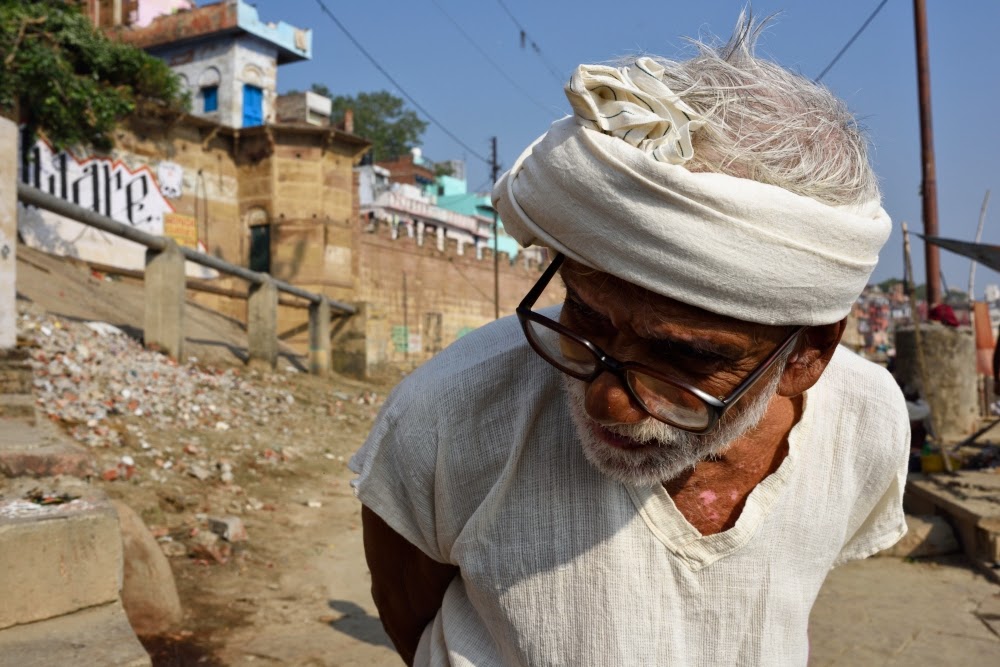
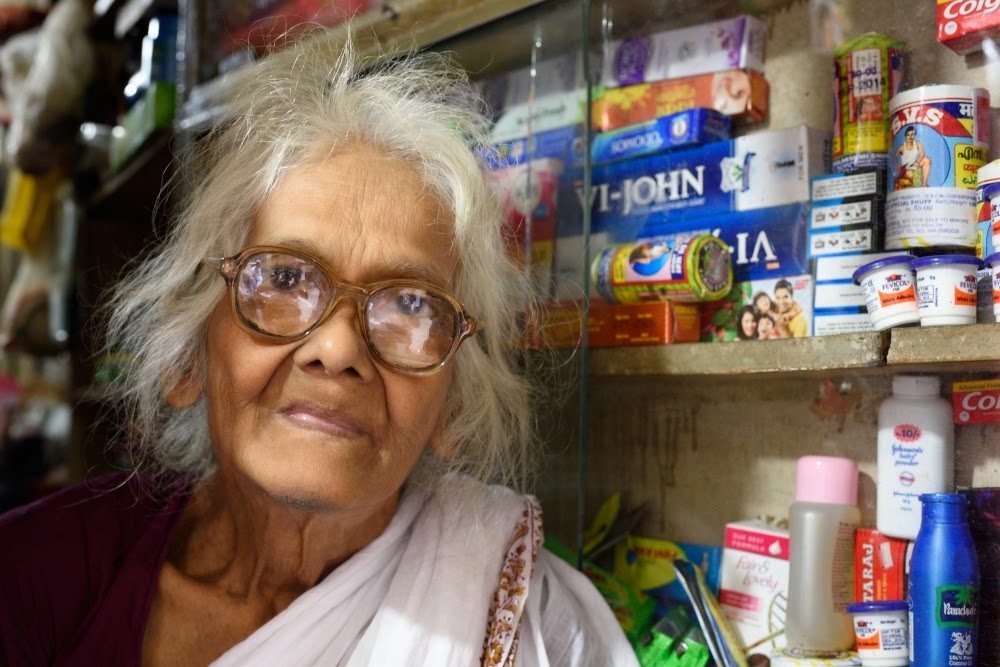
I just got back from a week-long street photography workshop with Maciej Dakowicz in Varanasi, India. What an experience - in many respects! Firstly my street photography progressed further than I could ever have expected or hoped for (to the point where I'm now thinking I need to delete all the old rubbish off my Flickr account!), and secondly I had an amazing travel experience to what must be one of the strangest places in the world and thirdly I've made some great new friends from Poland, Thailand and Austria, who I really hope to see and shoot with again.
So what was it like? Well to start with, Dakowicz worked us incredibly hard. All day, every day. Even one day when I had a cold starting and felt really rubbish and had cried off for the morning, I got a text an hour later to tell me to get out, meet up with the others and shoot. This continued momentum for the whole seven days meant that we made steady progress. Every day we shot, edited, reviewed and learned from mistakes. Dakowicz took turns to shoot with us, so we got to learn from his approach first hand, see him take shots and then look at the back of his camera and realise that a tiny tweak here and there, a single step forwards, backwards or sideways, or a tiny tilt to the camera can make a massive difference.
Some of the technical aspects that Dakowicz taught us I had been told before, but going through these aspects again, putting them into practice straight away, checking and correcting in the field, getting feedback the same day, and then trying again the next day, meant that they truly sank in. I also think I understood more about the technical points as in really understanding how important it is to get them right and what a difference a tiny error can make to the whole picture. And what a significant improvement a tiny correction can make to the whole picture.
I also realised that my preference for square format, might actually be due to laziness as it is easier to shoot squares than rectangles.......Dakowicz taught us (and insisted on) filling the frame and getting it right in shooting (no cropping)!
So of all the learning points, here are those that resonated most with me (all shot with Nikon D810 and 35mm lens):
Exposing for highlights

Capturing a "moment"

Layering your subjects with no overlaps

Getting close to take portraits
Finding humour

Putting the subject inside frames

Creating a mystery

Spotting an illusion

Using backgrounds

Putting the focus point in the correct place (subject of story)

Using colours effectively

In addition, I also learnt practical things, like how to carry my camera and rucksack in a way that gave me freedom of movement with no neck ache and other annoyances (how did this take so long to work out?), and also how to approach and engage with people.
Finally, and this was very useful for my coursework, we learned how to construct a portfolio, how individual images need to work with each other, how to keep colours and tones consistent in a collection of photographs, and to use the same format (horizontal rectangles - not verticals or squares - within the same series.
What would I change for next time? Only practical things. For a start, I wouldn't take my 24-70mm and 70mm-200mm lenses. I didn't need them and they were heavy additions to my baggage. I only needed my 35mm lens. I would though take my Nikon D5000 plus 35mm lens as a back up. I was worried the whole time about what would happen if my main camera failed (which it didn't) so I would prefer to have a back up camera next time.
Another practical issue - take cold relief and vitamin C. I was prepared for all manner of illnesses and first aid situations, but not a cold, and this is and was the most likely thing to happen!
I already booked my next workshop for Myanmar in March 2015 and I can't wait.
For more images, please see: https://www.flickr.com/photos/124157193@N07/
And also Assignment Two!
Websites:
So what was it like? Well to start with, Dakowicz worked us incredibly hard. All day, every day. Even one day when I had a cold starting and felt really rubbish and had cried off for the morning, I got a text an hour later to tell me to get out, meet up with the others and shoot. This continued momentum for the whole seven days meant that we made steady progress. Every day we shot, edited, reviewed and learned from mistakes. Dakowicz took turns to shoot with us, so we got to learn from his approach first hand, see him take shots and then look at the back of his camera and realise that a tiny tweak here and there, a single step forwards, backwards or sideways, or a tiny tilt to the camera can make a massive difference.
Some of the technical aspects that Dakowicz taught us I had been told before, but going through these aspects again, putting them into practice straight away, checking and correcting in the field, getting feedback the same day, and then trying again the next day, meant that they truly sank in. I also think I understood more about the technical points as in really understanding how important it is to get them right and what a difference a tiny error can make to the whole picture. And what a significant improvement a tiny correction can make to the whole picture.
I also realised that my preference for square format, might actually be due to laziness as it is easier to shoot squares than rectangles.......Dakowicz taught us (and insisted on) filling the frame and getting it right in shooting (no cropping)!
So of all the learning points, here are those that resonated most with me (all shot with Nikon D810 and 35mm lens):
Exposing for highlights
Capturing a "moment"
Layering your subjects with no overlaps
Getting close to take portraits
Finding humour
Putting the subject inside frames
Creating a mystery
Spotting an illusion
Using backgrounds
Putting the focus point in the correct place (subject of story)
Using colours effectively
In addition, I also learnt practical things, like how to carry my camera and rucksack in a way that gave me freedom of movement with no neck ache and other annoyances (how did this take so long to work out?), and also how to approach and engage with people.
Finally, and this was very useful for my coursework, we learned how to construct a portfolio, how individual images need to work with each other, how to keep colours and tones consistent in a collection of photographs, and to use the same format (horizontal rectangles - not verticals or squares - within the same series.
What would I change for next time? Only practical things. For a start, I wouldn't take my 24-70mm and 70mm-200mm lenses. I didn't need them and they were heavy additions to my baggage. I only needed my 35mm lens. I would though take my Nikon D5000 plus 35mm lens as a back up. I was worried the whole time about what would happen if my main camera failed (which it didn't) so I would prefer to have a back up camera next time.
Another practical issue - take cold relief and vitamin C. I was prepared for all manner of illnesses and first aid situations, but not a cold, and this is and was the most likely thing to happen!
I already booked my next workshop for Myanmar in March 2015 and I can't wait.
For more images, please see: https://www.flickr.com/photos/124157193@N07/
And also Assignment Two!
Websites:
- Maciej Dakowicz available from http://www.maciejdakowicz.com/ [accessed 31 October 2014]
Sunday, 5 October 2014
Assignment Two - Preparation - Photographing the unseen
Sunday 5 October
The assignment asks us to reflect on what kinds of subjects might be seen as un-photographable and how we might go about portraying them using photography (around seven ideas), with the objective of developing one of those ideas into a visually consistent series of 7-10 images. Here are my reflections:
This will be an unplanned exercise, as the images will need to reflect spontaneity to convey the excitement and discovery. I will be participating in an intensive seven-day street photography workshop with Maciej Dakowicz, so there is also the element of excitement of working with a photography hero and learning new techniques. I have no idea how this is going to turn out as a finished piece of work! All I know is that it will be in colour :)
Sunday 23 November
Once I'd completed all the exercises and set about finalising my assignment submission, I wondered about the inclusion of text. The Assignment instructions did not ask for text or captions, and my feedback from Assignment One was that I did not need the captions in that particular context. BUT a lot of the work that we did for Part Two was about text and the relationship between text and image. Would it be an error to omit text on that basis? Did I want to guide the viewer into a reaction or did I want the photos to speak for themselves?
I searched other students' blogs for ideas, and came across Malcolm Burton. He did use text to accompany his images for this assignment, but I felt that for my purposes it would give too much away and not leave enough ambiguity.
That decided, I realised that the images needed to speak for themselves and that I wanted amiguity. Wonder by its very definition is ambiguous as it is not about certainty, so I therefore needed to preserve that concept. The whole subject of wonder is interpretative and I did not to guide the reaction to individual photographs but more to take the reader on a journey - like peeling an onion - I wanted to strip off layers. What I did do though was to include a brief introduction to set the scene by attempting a meaning of the word itself. Fingers crossed.....
In terms of executing the assignment, it happened as I'd predicted: completely right-brained. I did not plan these photographs, they were selected from my overall portfolio produced in Varanasi during the workshop I took part in. I did have the subject matter in the back of my mind while I was there but I was not consciously shooting for this assignment. I then selected the photographs afterwards using the usual star system in my software for editing. The pictures I selected for this assignment are the best of those I considered illustrated the theme metaphorically and I also aimed for similar colours and tones (cool, apart from the orange in the first one chosen to punctuate the start of the journey and the wonder of every new day). I put them together in a sequence of what you can image is the start of a positive experience of wonder, through to confusion, looking in to another scene from the outside (but not really being able to see what's going on), followed by a sense of alarm, and then on to something more sinister, ending with possible fear.
See here for my submission.
References:
The assignment asks us to reflect on what kinds of subjects might be seen as un-photographable and how we might go about portraying them using photography (around seven ideas), with the objective of developing one of those ideas into a visually consistent series of 7-10 images. Here are my reflections:
- The five senses: sight, hearing, taste, touch, smell. You could photograph somebody actively performing a sense, e.g. a person sniffing something or walking with headphones on, but you could not photograph the sensation of experiencing the sense. For instance, you would not be able to photograph what something smells like - you can only photograph the thing itself and hope that the viewer can imagine the smell.
- Emotions: happiness, sadness. You could photograph somebody's expression and hope that their face shows emotion, but can you really capture what they are feeling? Can a photographer capture their own emotions? In addition, the emotion conveyed also depends on the interpretation of the viewer. For instance, I could capture a desolate landscape with mist and a lot of negative space, which one person might interpret as me feeling sad and isolated, but in actual fact, I would feel happy in such a scene, so it's relative. The Dad Project by Briony Campbell is a very poignant example of a piece of work that has captured strong emotions in photography.
- Anticipation: how would you capture anticipation? You would have to set a scene so that it was obvious what was about to happen next? How would you show photographically what you are anticipating?
- Fear: you could capture fear by the expression in somebody's face, but can you really capture fear that you as a photographer are experiencing? How would you show your own sense of dread, sickness, shakes?
- Dreams: dreams are a unique and subconscious experience - each person's dreams are individual, personal and not seen by other people. They could however be reconstructed in photography as a narrative, but I don't think you'd be able to just go out and photograph a dream, you'd have to stage a scene and be creative, possibly even surreal.
- Needs: hunger, thirst. Again, you could capture another person's hunger or thirst, but not your own. You'd have to photograph things that conveyed the concepts of hunger and thirst.
- Wonder: how do you capture the wonder? Is it seeing something amazing for the very first time? Could it also be applied to something sinister? Sure you can photograph the thing or the scene itself, but how do you capture the reaction of wonder. Is it excitement (or even trepidation) in response to a situation? Is it more ambiguous than that? Is it a state of confusion?
This will be an unplanned exercise, as the images will need to reflect spontaneity to convey the excitement and discovery. I will be participating in an intensive seven-day street photography workshop with Maciej Dakowicz, so there is also the element of excitement of working with a photography hero and learning new techniques. I have no idea how this is going to turn out as a finished piece of work! All I know is that it will be in colour :)
Sunday 23 November
Once I'd completed all the exercises and set about finalising my assignment submission, I wondered about the inclusion of text. The Assignment instructions did not ask for text or captions, and my feedback from Assignment One was that I did not need the captions in that particular context. BUT a lot of the work that we did for Part Two was about text and the relationship between text and image. Would it be an error to omit text on that basis? Did I want to guide the viewer into a reaction or did I want the photos to speak for themselves?
I searched other students' blogs for ideas, and came across Malcolm Burton. He did use text to accompany his images for this assignment, but I felt that for my purposes it would give too much away and not leave enough ambiguity.
That decided, I realised that the images needed to speak for themselves and that I wanted amiguity. Wonder by its very definition is ambiguous as it is not about certainty, so I therefore needed to preserve that concept. The whole subject of wonder is interpretative and I did not to guide the reaction to individual photographs but more to take the reader on a journey - like peeling an onion - I wanted to strip off layers. What I did do though was to include a brief introduction to set the scene by attempting a meaning of the word itself. Fingers crossed.....
In terms of executing the assignment, it happened as I'd predicted: completely right-brained. I did not plan these photographs, they were selected from my overall portfolio produced in Varanasi during the workshop I took part in. I did have the subject matter in the back of my mind while I was there but I was not consciously shooting for this assignment. I then selected the photographs afterwards using the usual star system in my software for editing. The pictures I selected for this assignment are the best of those I considered illustrated the theme metaphorically and I also aimed for similar colours and tones (cool, apart from the orange in the first one chosen to punctuate the start of the journey and the wonder of every new day). I put them together in a sequence of what you can image is the start of a positive experience of wonder, through to confusion, looking in to another scene from the outside (but not really being able to see what's going on), followed by a sense of alarm, and then on to something more sinister, ending with possible fear.
See here for my submission.
References:
- Campbell, B. (2011) The Dad Project [online] available from http://www.brionycampbell.com/wp-content/uploads/2013/03/The_Dad_Project_Briony_Campbell.pdf [accessed 11 October 2014]
- Maciej Dakowicz available from http://www.maciejdakowicz.com/ [accessed 5 October 2014]
- Burton, M. (2014) Context and Narrative Learning Blog: Assignment Two - time goes faster as you get older available from http://malsblog322.wordpress.com/2014/11/01/assignment-2-photographing-the-unseen/ [accessed 23 November 2014]
Saturday, 2 August 2014
Planning and Study Timetable
Page 12 of the course materials ask for planning!
Study schedule
My study schedule is Saturdays. I have two Saturdays ear-marked a month that I will ruthlessly reject all social invitations for. This gives me a minimum of 20 hours a month for shooting. Up to now this system works ok. I also quite often have Sunday mornings, which works out at about another 10-15 hours a month. After that, I probably go to at least one exhibition, event, or seminar a month minimum, so let's say 2 hours (research!). Then, I read on the train (or look at photos on my ipad) so that's another 40 hours a month (but can't really count that towards course work, as is mostly surfing). The extra 10 that I am missing for course work come out of time after work (which is rare), or Saturdays that are longer than 10 hours' work, or the occasional day of work (also rare). So it's a bit of a jumble, but I get through ok. I do want to complete C&N in a year though, so I need to step up a bit!
I work outdoors for shooting - wherever I need to go - and for processing / blog writing on my laptop on the sofa (very bad) - and for reading, usually on the train to work.
Assignments
As I'm aiming to complete within a year, my assignment schedule looks like this:
Hoping to make significant progress in travel / street photography this year and have trips planned to Varanasi, India in October (workshop with Maciej Dakowicz) and Japan in December (holiday including snow monkeys inspired by Jasper Doest!). I'm not sure either will help with assignments (two and three) - and there is always the risk of needing to reshoot - which is not possible with travel), but we'll see nearer the time. As I aspire to being a travel photographer (well one of the things I'm aspiring to at the moment) - I do want to use as much material as I can from travel experiences.
Maybe for Assignment Two, my list of things un-photographable could be emotions that I experience being on another continent, far away from home and husband, and then how I deal with the poverty, kids in the street, sick dogs etc that I will see in India?
Keeping the diary for Assignment Three during my two weeks in Japan might be an interesting exercise as I will be away from the routine and pressure of going to work everyday and more able to be "myself". I can then try to take images later to represent how I felt in Japan - that would be an interesting twist! Or try to capture a photographic journey both physically and emotionally. I'm expecting Japan to be a mixture of wildlife, landscape and street photography (including street portraits).
So actually, I've already answered my own questions! This is how my left-brain kicks in!
Study schedule
My study schedule is Saturdays. I have two Saturdays ear-marked a month that I will ruthlessly reject all social invitations for. This gives me a minimum of 20 hours a month for shooting. Up to now this system works ok. I also quite often have Sunday mornings, which works out at about another 10-15 hours a month. After that, I probably go to at least one exhibition, event, or seminar a month minimum, so let's say 2 hours (research!). Then, I read on the train (or look at photos on my ipad) so that's another 40 hours a month (but can't really count that towards course work, as is mostly surfing). The extra 10 that I am missing for course work come out of time after work (which is rare), or Saturdays that are longer than 10 hours' work, or the occasional day of work (also rare). So it's a bit of a jumble, but I get through ok. I do want to complete C&N in a year though, so I need to step up a bit!
I work outdoors for shooting - wherever I need to go - and for processing / blog writing on my laptop on the sofa (very bad) - and for reading, usually on the train to work.
Assignments
As I'm aiming to complete within a year, my assignment schedule looks like this:
- Assignment One - end September 2014
- Assignment Two - end November 2014 (India?)
- Assignment Three - end February 2015 (Japan?)
- Assignment Four - end April 2015
- Assignment Five - end July 2015
Hoping to make significant progress in travel / street photography this year and have trips planned to Varanasi, India in October (workshop with Maciej Dakowicz) and Japan in December (holiday including snow monkeys inspired by Jasper Doest!). I'm not sure either will help with assignments (two and three) - and there is always the risk of needing to reshoot - which is not possible with travel), but we'll see nearer the time. As I aspire to being a travel photographer (well one of the things I'm aspiring to at the moment) - I do want to use as much material as I can from travel experiences.
Maybe for Assignment Two, my list of things un-photographable could be emotions that I experience being on another continent, far away from home and husband, and then how I deal with the poverty, kids in the street, sick dogs etc that I will see in India?
Keeping the diary for Assignment Three during my two weeks in Japan might be an interesting exercise as I will be away from the routine and pressure of going to work everyday and more able to be "myself". I can then try to take images later to represent how I felt in Japan - that would be an interesting twist! Or try to capture a photographic journey both physically and emotionally. I'm expecting Japan to be a mixture of wildlife, landscape and street photography (including street portraits).
So actually, I've already answered my own questions! This is how my left-brain kicks in!
Subscribe to:
Posts (Atom)