Waiting for Summer

Waiting for Summer
Showing posts with label Varanasi. Show all posts

Sunday, 23 November 2014

Part Two - Narrative: Reflections

Wow - my feet haven't touched the ground!  But instead of feeling tired, as I did at the end of Part One, I feel inspired, energised and ready for Part Three.  I did have a bit of a blip though during Part Two, maybe a part of the come down from my trip to India, but I went through a bit of block with my course work, as in not wanting to do it.  I kept asking myself why I'd chosen this academic route, when basically all I want to do is get out and take photos!  I've resolved that now (yesterday actually), the bigger picture is that one day, I'd like to make a living from photography, and that will include teaching, so I need the broader understanding and skill set and have to be careful not to lose sight of that.  I do however need to revise my timetable a bit, as I'm not getting out as much as I'd like, and at the end of the day, I need to practice to progress my personal ambitions.  I currently allow 2-3 weekends a month to complete my course work, and then I read/research/surf on my daily commute.  I think I need to try, as hard as it is, to "work after work", to put in one evening a week for course work.  That means also putting it on my office calendar to avoid staying late at work.  I will start doing this in the New Year, and this will free up a bit more time at weekends for practicing my street photography :)

So, during Part Two I have (in no particular order):
  • Taken part in a week-long Street Photography workshop in Varanasi, India with Maciej Dakowicz 
  • Learnt a lot about different ways of supplementing images with text and what that achieves
  • Learnt about loss of authorial control
  • Learnt about the difference between relay and anchor text
  • Understood how images can be ambiguous if not supported by text
  • Learnt about photographing the unseen
  • Met Dougie Wallace again at his Shoreditch Wildlife launch event
  • Reviewed 2 exhibitions
  • Read 0 photography books!!  (ooops.....)
  • Won a photography competition at work!  Yay!
  • Had one of my photographs used by Maciej Dakowicz on his website :o)
But, most importantly, a while ago, I wasn't sure where my photography was heading.  I was flitting between street, travel, wildlife, landscape, conceptual, art, documentary, trying out photojournalism....I had no idea where I was going.  Following my experience in Varanasi, I now known for certain exactly where I'm going.  I found this blend of street/travel photography very exciting and challenging - and this is what I want to do - every day that I can!

Finally, I need to do something about the tag list for this blog -it's getting a bit long....not quite sure what to do about it, but I'll give it some thought.

Assignment Two - Reflections

I took a gamble with Assignment Two in shooting it overseas knowing that I would not be able to go back and reshoot in the same location.  My tutor warned me about this, however, as the direction I want my photography to progress with is exactly this blend of street/travel photography, I am going to have to learn to get it right on location.  In fact, this is the kind of pressure that many commercial photographers and photojournalists are under each time they shoot, so for me this is a reality I will also have to live with and should therefore practice.  And I will do it again and again, as this is what I want to improve on, and I have decided that I will try to shoot Assignment Three in Japan over Christmas in Street/Travel Photography style.

I think though, the gamble paid off.  I have a series of 7 images that I believe fulfill the brief.  The assignment specifically mentioned that the series must be visually consistent and tightly edited, and I think they are, or at least I tried to achieve that.  The colours/tones are very similar: mostly cool with the exception of the orange in the sunrise picture which punctuates the start of the series.  In addition, each photograph leads into the next: they are all visually connected with each other by colour/tone or also by an element within the frame:
  • In photos 1 & 2, both men are covering their faces
  • Photo 3 provides the head and upper torso that is hidden from view in photo 2
  • In Photo 3, the man is peering into the room in photo 4
  • Photos 4 and 5 both have an activity taking place inside a rectangle - similar compositions
  • Photo 5 the man is looking out of the frame slightly alarmed at the dog in photo 6
  • In photo 7, the child is looking back at the dog (also looking alarmed).
I could have used more than seven photographs, but the other three I had did not really add anything more to the story.  This was definitely a case of less is more! 

Presenting these images for an assignment though was also an emotive decision.  I had such an amazing time during that week with Maciej Dakowicz, that there was no way I was not going to use the images!  But, I hope it works out as a complete assignment - the emotional stakes are quite high, so I will be disappointed if it's not a success!

In terms of the Assessment Criteria, here are my thoughts:

Demonstration of technical and visual skills

During that week in India, I found that my technical and visual skills progressed way beyond my expectations.  I was so happy with the process that I booked another workshop in Myanmar in March again with Dakowicz as I wanted to take it further still.  I learnt so much about exposure, composition, story telling, observing, and so on, and I think it is reflected in these images.  I also became a lot braver about being closer to people when I took photographs.  I also learnt from Dakowicz how to put a portfolio together - how images need to connect with each other, and this has also been demonstrated in this assignment.

Quality of outcome

I'm happy with the quality of outcome - of course I am - I've never produced anything like this standard of work before (hope that doesn't sound too immodest but I'm still on a high from the whole experience)!  The images are all clear, correctly exposed, no noise etc.  My only concern is with the text - should I have captioned the images or included more text?  I think the approach I took is the right one, I do want the viewer to wonder what is going on and think about their own reaction of wonder, without too much guidance, but I'm not 100% certain that I should not have included more guidance text.

Demonstration of creativity

This is definitely my most creative piece of work yet and I believe that personal voice is now starting to show.  The best thing though is that I have "found myself".  I've realised that I can combine my two biggest passions in life: travel and photography, and that my photography now has some direction.  In my Reflections to Assignment One, I mentioned that I felt that various strands of photography were emerging.  That's all over now.  This experience was so exciting that I cannot bring myself to photograph anything else at the moment, and certainly not every day urban scenes.  I can't wait to be able to have another experience like this.  I get an adrenalin rush from Street Photography anyway, and I think it's time now to just focus on that, and combine it with travel where I can.

I am aware though, that, although the way in which I've used these photos is original, on account of the assignment directions, but, overall, my images from Varanasi look similar to other photographs I've seen taken by other people, and of course they are inspired by the style of Dakowicz.  They are original for me, but overall, I need to step up still in finding more a more unique perspective.  These broadly look like many people's travel photographs, so I feel like I'm just on the first step of the ladder now.  But, I am thrilled though that I've found my ladder!  I think it might have always been there, and I have spent the past six months intensely focusing on Street Photography, but until now, I wasn't really ready to rule out other avenues.  But I am now :)

Context 

Research for this assignment was limited to the work directed by the course materials.  I got a really good sense through the projects, exercises and research points of what photographing the unseen can mean, i.e. through gesture, traces, metaphoric illustration, so I hope that this has come through in this piece of work.

Overall

Overall I am extremely pleased (as you probably gathered....sorry....) with this work.  I think where I may get some learning points / constructive feedback will be in how I put the series together - were the photos in the right order - does the onion layers idea come through?  Have I really captured the concept of "wonder"?  Is this too illustrative and not sufficiently metaphorical?  And also whether I should have used more text/captions.  I will be interested to see my tutor's response and whether the ambiguity I tried to achieve came through.

Websites:

Saturday, 15 November 2014

More about Maciej Dakowicz Photography Workshops

Very very proud that one of my photographs is now featured on Maciej Dakowicz's Photography Workshops website.  This was originally taken as a joke / souvenir shot but really pleased it's been used as a banner!


Here is the original:


Websites:

Monday, 3 November 2014

Part Two - Narrative: Project Two - Image and text: Exercise 2 - Illustrating a poem

Exercise 2 of Project 2 (Image and Text) requires us to chose a poem that resonates with us and interpret it through photographs by giving a sense of the feeling of the poem and the essence it exudes.  The poem I have chosen is called Varanasi, The Holy City and is by S.D. Tiwari.  I have contacted Mr Tiwari for permission to reproduce the poem in full in this post, but while I am waiting for a response, here is the link:

http://allpoetry.com/poem/9310815-Varanasi--the-Holy-City-by-S.-D.-Tiwari

As the title suggests, the poem is about the Holy City of Varanasi in India, which is situated on the Ganges, India's holy river.  The first verse of the poem describes the holy act purification of the soul by bathing in the Ganges, a shrine for Hindu people.  The second verse describes the morning rituals, the mantras and hymns that pilgrims sing, and the fact that by virtue of being there and participating, you are already in heaven.  The third verse goes on to explain that Budhism was also founded in Varanasi and great artistic creations have taken place.  So in essence, the poem to me speaks of the cycles of purification, state of heaven, birth and the subsequent enlightenment that we can achieve.

My photos that illustrate this cycle (all shot in Varanasi) are:


Websites:

Friday, 31 October 2014

Assignment Two - Photographing the unseen - Wonder

What does WONDER mean?
  • to be filled with amazement, admiration and awe?
  • to think or speculate?
  • to doubt?
I wonder.....


1


2


3


4

 
5


6


7


Maciej Dakowicz Street Photography Workshop in Varanasi, India

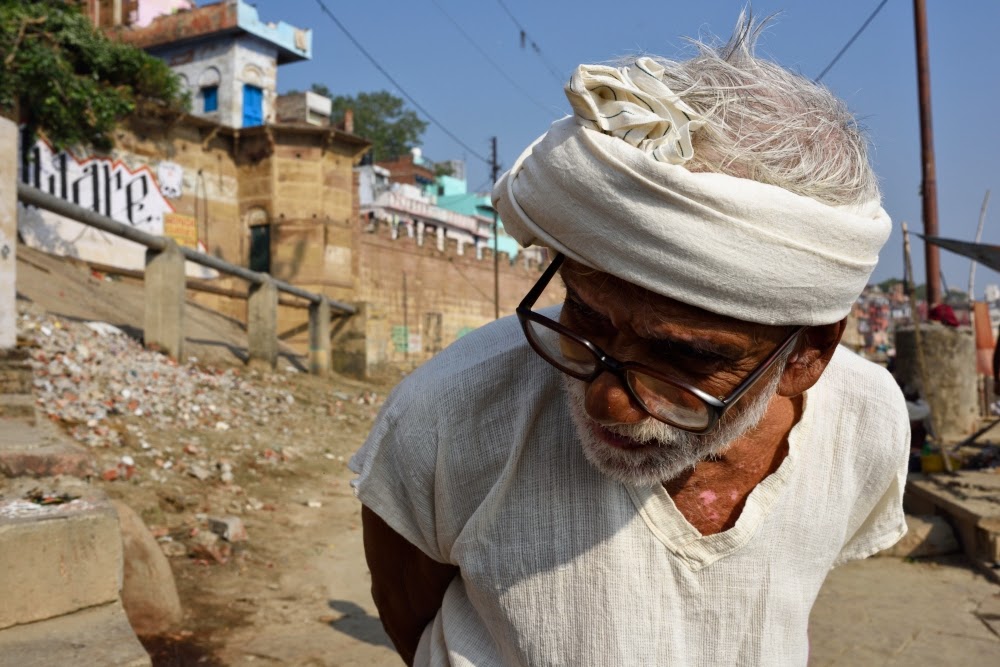
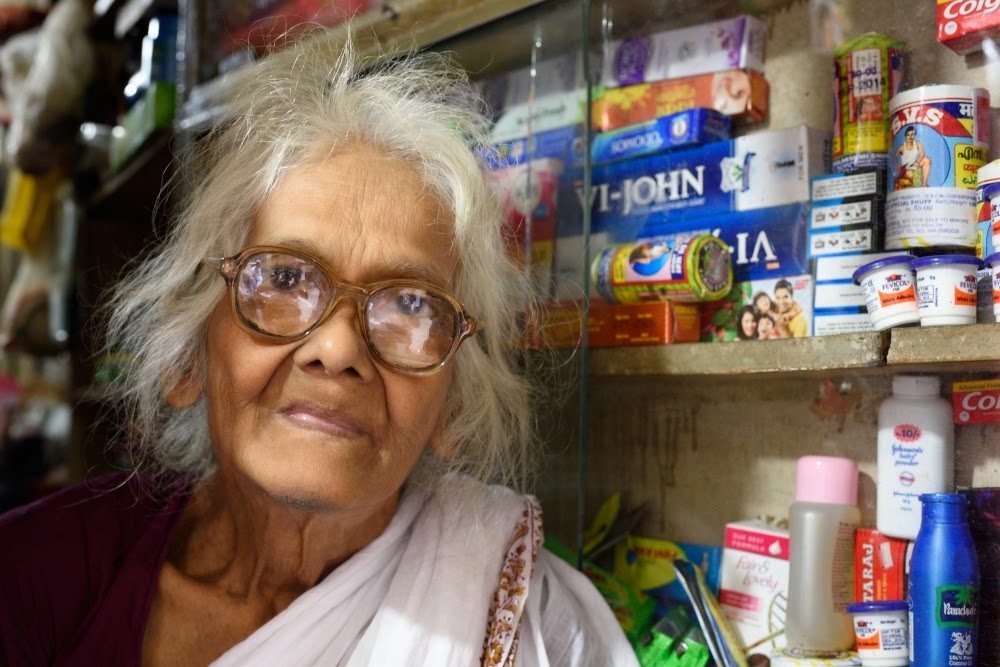
I just got back from a week-long street photography workshop with Maciej Dakowicz in Varanasi, India.  What an experience - in many respects!  Firstly my street photography progressed further than I could ever have expected or hoped for (to the point where I'm now thinking I need to delete all the old rubbish off my Flickr account!), and secondly I had an amazing travel experience to what must be one of the strangest places in the world and thirdly I've made some great new friends from Poland, Thailand and Austria, who I really hope to see and shoot with again.

So what was it like?  Well to start with, Dakowicz worked us incredibly hard.  All day, every day.   Even one day when I had a cold starting and felt really rubbish and had cried off for the morning, I got a text an hour later to tell me to get out, meet up with the others and shoot.  This continued momentum for the whole seven days meant that we made steady progress.  Every day we shot, edited, reviewed and learned from mistakes.   Dakowicz took turns to shoot with us, so we got to learn from his approach first hand, see him take shots and then look at the back of his camera and realise that a tiny tweak here and there, a single step forwards, backwards or sideways, or a tiny tilt to the camera can make a massive difference.

Some of the technical aspects that Dakowicz taught us I had been told before, but going through these aspects again, putting them into practice straight away, checking and correcting in the field, getting feedback the same day, and then trying again the next day, meant that they truly sank in.  I also think I understood more about the technical points as in really understanding how important it is to get them right and what a difference a tiny error can make to the whole picture.  And what a significant improvement a tiny correction can make to the whole picture.

I also realised that my preference for square format, might actually be due to laziness as it is easier to shoot squares than rectangles.......Dakowicz taught us (and insisted on) filling the frame and getting it right in shooting (no cropping)!  

So of all the learning points, here are those that resonated most with me (all shot with Nikon D810 and 35mm lens):

Exposing for highlights


Capturing a "moment"


Layering your subjects with no overlaps


Getting close to take portraits


Finding humour


Putting the subject inside frames


Creating a mystery


Spotting an illusion


Using backgrounds


Putting the focus point in the correct place (subject of story)


Using colours effectively


In addition, I also learnt practical things, like how to carry my camera and rucksack in a way that gave me freedom of movement with no neck ache and other annoyances (how did this take so long to work out?), and also how to approach and engage with people.

Finally, and this was very useful for my coursework, we learned how to construct a portfolio, how individual images need to work with each other, how to keep colours and tones consistent in a collection of photographs, and to use the same format (horizontal rectangles - not verticals or squares - within the same series. 

What would I change for next time?  Only practical things.  For a start, I wouldn't take my 24-70mm and 70mm-200mm lenses.  I didn't need them and they were heavy additions to my baggage.  I only needed my 35mm lens.  I would though take my Nikon D5000 plus 35mm lens as a back up.  I was worried the whole time about what would happen if my main camera failed (which it didn't) so I would prefer to have a back up camera next time.

Another practical issue - take cold relief and vitamin C.  I was prepared for all manner of illnesses and first aid situations, but not a cold, and this is and was the most likely thing to happen!

I already booked my next workshop for Myanmar in March 2015 and I can't wait. 

For more images, please see:  https://www.flickr.com/photos/124157193@N07/

And also Assignment Two!

Websites:

Sunday, 5 October 2014

Assignment Two - Preparation - Photographing the unseen

Sunday 5 October

The assignment asks us to reflect on what kinds of subjects might be seen as un-photographable and how we might go about portraying them using photography (around seven ideas), with the objective of developing one of those ideas into a visually consistent series of 7-10 images.  Here are my reflections:
  1. The five senses: sight, hearing, taste, touch, smell.  You could photograph somebody actively performing a sense, e.g. a person sniffing something or walking with headphones on, but you could not photograph the sensation of experiencing the sense.  For instance, you would not be able to photograph what something smells like - you can only photograph the thing itself and hope that the viewer can imagine the smell.
  2. Emotions: happiness, sadness.  You could photograph somebody's expression and hope that their face shows emotion, but can you really capture what they are feeling?  Can a photographer capture their own emotions?  In addition, the emotion conveyed also depends on the interpretation of the viewer.  For instance, I could capture a desolate landscape with mist and a lot of negative space, which one person might interpret as me feeling sad and isolated, but in actual fact, I would feel happy in such a scene, so it's relative.  The Dad Project by Briony Campbell is a very poignant example of a piece of work that has captured strong emotions in photography.
  3. Anticipation: how would you capture anticipation?  You would have to set a scene so that it was obvious what was about to happen next?  How would you show photographically what you are anticipating?
  4. Fear: you could capture fear by the expression in somebody's face, but can you really capture fear that you as a photographer are experiencing?  How would you show your own sense of dread, sickness, shakes?
  5. Dreams: dreams are a unique and subconscious experience - each person's dreams are individual, personal and not seen by other people.  They could however be reconstructed in photography as a narrative, but I don't think you'd be able to just go out and photograph a dream, you'd have to stage a scene and be creative, possibly even surreal.
  6. Needs: hunger, thirst.  Again, you could capture another person's hunger or thirst, but not your own.  You'd have to photograph things that conveyed the concepts of hunger and thirst.
  7. Wonder: how do you capture the wonder?  Is it seeing something amazing for the very first time?  Could it also be applied to something sinister?  Sure you can photograph the thing or the scene itself, but how do you capture the reaction of wonder.  Is it excitement (or even trepidation) in response to a situation?  Is it more ambiguous than that?  Is it a state of confusion?
For Assignment Two, I am going to attempt the 7th idea, which I hope to execute in Varanasi in India.  Having never been to India before, I really don't know what to expect.  Sure I've seen other people's photographs, but how do I capture the concept of wonder, in a way that the viewer understands that from the output?

This will be an unplanned exercise, as the images will need to reflect spontaneity to convey the excitement and discovery.  I will be participating in an intensive seven-day street photography workshop with Maciej Dakowicz, so there is also the element of excitement of working with a photography hero and learning new techniques.  I have no idea how this is going to turn out as a finished piece of work!  All I know is that it will be in colour :)

Sunday 23 November

Once I'd completed all the exercises and set about finalising my assignment submission, I wondered about the inclusion of text.  The Assignment instructions did not ask for text or captions, and my feedback from Assignment One was that I did not need the captions in that particular context.  BUT a lot of the work that we did for Part Two was about text and the relationship between text and image.  Would it be an error to omit text on that basis?  Did I want to guide the viewer into a reaction or did I want the photos to speak for themselves?

I searched other students' blogs for ideas, and came across Malcolm Burton.  He did use text to accompany his images for this assignment, but I felt that for my purposes it would give too much away and not leave enough ambiguity.

That decided, I realised that the images needed to speak for themselves and that I wanted amiguity.  Wonder by its very definition is ambiguous as it is not about certainty, so I therefore needed to preserve that concept.  The whole subject of wonder is interpretative and I did not to guide the reaction to individual photographs but more to take the reader on a journey - like peeling an onion - I wanted to strip off layers.  What I did do though was to include a brief introduction to set the scene by attempting a meaning of the word itself.  Fingers crossed.....

In terms of executing the assignment, it happened as I'd predicted: completely right-brained.  I did not plan these photographs, they were selected from my overall portfolio produced in Varanasi during the workshop I took part in.  I did have the subject matter in the back of my mind while I was there but I was not consciously shooting for this assignment.  I then selected the photographs afterwards using the usual star system in my software for editing.  The pictures I selected for this assignment are the best of those I considered illustrated the theme metaphorically and I also aimed for similar colours and tones (cool, apart from the orange in the first one chosen to punctuate the start of the journey and the wonder of every new day).  I put them together in a sequence of what you can image is the start of a positive experience of wonder, through to confusion, looking in to another scene from the outside (but not really being able to see what's going on), followed by a sense of alarm, and then on to something more sinister, ending with possible fear.

See here for my submission.

References:
Websites: