Waiting for Summer

Waiting for Summer
Showing posts with label travel photography. Show all posts

Saturday, 14 March 2015

Over and out

For anyone following the blog, this is my last post.  I have decided to cease my OCA studies and focus specifically on my street photography and shape my development myself.

If you like street photography and want to see more, go to:

note - website is still under construction so keep checking back!

Sunday, 8 February 2015

Assignment Three - Self-portrait: Reflections

I took a gamble again with Assignment Three shooting it overseas, but on this occasion, I know I can re shoot in the UK if I have to.  The themes will be the same, but different images. Hopefully it won't come to that!  I'm just pleased that I had another opportunity to use street/travel photography themes for an assignment.

I decided on this occasion to submit five images.  Using a tightly edited and visually consistent approach worked well for Assignment Two, so I applied the same methodology.  Adding more than five images would not have added extra information to the story; it already said what I wanted to say, and adding more (as I found out) risked introducing images that were not visually consistent.

Overall, my criticism of this presentation is whether the narrative is actually about the speed of the passage of time, or the volume of work I have to do.  Hopefully, the relationship between the two elements and the fact that they have an adverse impact on each other comes through.

It was hard for me to try to shoot deliberately blurred scenes; I usually aim for absolute precision.  Although actually, apart from Image 1, which was deliberate, and 2 where I tried to be a bit sharper, the others are a bit fuzzy by happy accident.

The images I like the most are 1, 3 and 5.  I really like image 1 from Tokyo: it conveys the concept of a flood of stuff (represented by the people on the crossing) coming towards me (the daily tidal wave) and the street photography elements of the matching jumpers on the girls is an added bonus.  This was shot handheld at the slowest shutter speed I dared without blurring the background - 1/15s.  I think I managed to get sufficient softness without losing outlines.  The inclusion of the "stop hand" in the top left corner, works well as the "voice of reason" telling me to slow down, even though it's impossible.  And of course Starbucks in the background: coffee to start the day!  Image 3 from Osaka is a street photography "moment" shot through the back of the machine, creating the illusion of multiplying tasks (represented by the reflection of the bears) and the added twist of the man grabbing a toy instead of the claw.  Image 5 from the snow monkey park in Jigokudani Yaen-Koen on Christmas Day was an accident.  I didn't know I'd taken it until that evening when I was editing my 1000 shots from that day and I found it.  It was taken with a shutter speed of 1/160s so that tells you how fast they shake their heads!  I was trying at the time to create a cute monkey bathing picture, and didn't mean to take a demonic head-shaking "Exorcist" monkey.  I'm glad I didn't realise it was there on the day, as I would probably have deleted it, thinking it was too blurred.

The image I don't like is Image 4.  This was taken in Miyaji (an island near Hiroshima) on New Year's Eve at the Chinkasai Fire Festival.  It was very crowded, raining and moving very fast.  I took a lot of shots trying to get the fire action with faces coming towards me (rather than backs) - they all failed - the framing was hard with everything moving so quickly.  This image is in fact a crop (hence it is a bit grainier than the others).

Image 2 is ok; it was an easy shot being indoors and not moving (although I had had a few drinks when I took it).  This is in fact the toilet door of the bar I was in and it immediately looked like the boxes on my Outlook calendar at work on week view when I saw it.  Later I noticed the two toilet symbols, which made me laugh, as that is also a problem (as in finding time)... the gap giving me time for one lunch break during the week was an added bonus.

In terms of the Assessment Criteria, here are my thoughts:

Demonstration of technical and visual skills

If I'm honest, I don't think technically I pushed myself or tried anything new really.  I was operating within my street photography comfort zone (much easier in Asia than in UK), and didn't attempt anything tricky.  Technically the hardest shot was Image 4 because of the movement, weather and light, and having to keep up with the festival participants.  I had an opportunity to try something more creative with Image 1 (i.e. use a tripod and try to get people ghosting or maybe use a zoom burst on one person), but because I already had an image I liked, which had sufficient (very slight) blur I decided to stick with that one.  I was also under time pressure by then.

Quality of outcome

Having made the claim that I was inspired recently by two contemporary images that made the most of a monochrome, blurred technique, I don't like very much what I made.  The pictures are very dark and my interpretation of the subject matter is very dark; this is quite a contrast from my what is (now) usual colourful and comical images.  I'm pleased though that I managed to put together something that said what I wanted it to say, but I don't feel that this is representative of my own style.  I'm not sure I have a style yet, but I don't think it's going to be this.  In terms of whether it hangs together as a series, the images are connected by theme and visual consistency, but not in terms of a linkage effect between each one, as I had achieved with Assignment Two.  This series needs the text to make it hang together.

Demonstration of creativity

I never know how to answer this part; yes I've made something - I've created something from nothing and I've tried a different way of presentation.  It's unlikely to be very original - I'm sure the Shibuya Crossing has been photographed a million times already.  I suppose from the point of view that I have presented images in a different way to normal, they could be considered creative, but on retrospect, I do prefer colour street photography.  I think all the images work better individually in colour, but they sit better together as a series in black and white.  And of course I wanted to make them seem sinister, which I think the black and white helps with.  I chose the black background and white writing to the presentation format to enhance the concept of this mysterious force that controls my life.  All in all, the interpretation (metaphorical) is probably more creative than the photography itself.

Context 

My research for this assignment continued with my general and on-going street photography work (see other posts under the "Street Photography" tag) and the two photographers I mentioned.  I am looking more and more now at contemporary photographers who have made the leap that I am trying to make, i.e. to find my own style.  By looking at contemporary photographers who were recently at my stage of the journey (rather than some of the older classics e.g. Bresson), and who perhaps a few years ago were where I am now, makes the end goal seem more attainable.  I did however follow my tutor's advice, which was to try to get deeper into one subject.

Overall

Overall I am pleased to have done this work, but I don't think introspection is the way forward for me.  I am more interested in observing the world around me than looking within. 

Assignment Three - Self-portrait: Submission


Assignment Three - Self-portrait: Preparation and Execution

All images reproduced in this post have been included by kind permission of their original author.  The copyright remains with the photographer stated.  All other images are my own.

Preparation

Assignment Three asks us to keep a diary for a couple of weeks, and then to use that to develop a self-portrait drawing upon the examples studied in Part Three of this module.

My approach to this project was initially to follow the instructions and to keep a diary for a period of time.  I chose to start the diary on 25 November 2014 and had intended to update it twice a day during my train journeys to and from work.  I made single entries on 25, 27, 28, 29, and 30 November, and 1, 3, 5 and 8 December.  On 16 December I wrote a summary of my entries.  The biggest observation was that I have no available time.  I couldn't even find the time to make a diary entry every day.  For a start, I don't always get a seat on the train, and when I did, I was more inclined to look at images online than to write about myself.  I realised that I am so busy with going to work, being at work, doing my coursework, researching, and then all the boring stuff like laundry etc, that I have no time, nor the inclination for introspection.  Both at work and at home, my life seems to hurtle along at 100mph getting me through an enormous volume of work.  The days fly past in a blurred rush of confusion.  From one week to the next, I don't even remember what I've done.

To manage this, my life has become compartmentalised into little boxes on electronic calendars where everything I have agreed to do or have to do is mapped out.  My work and home calendars do in fact look very similar.  At work there are no gaps due to meetings and deadlines, at home there are no gaps due to photography commitments and traveling; the home calendar of course being a nice problem to have!  But, if I don't do the allotted thing at the right time, in the time that I have allowed, it either doesn't happen, or there is a knock-on domino effect and something else suffers.  Somewhere in the cracks, I see my poor husband, dogs, friends and rest of family.  It seems that time takes the form of an out-of-control all-consuming monster that has a mind and a course of its own that I have no choice but to keep up with; I certainly can't slow it down.  At night, I struggle to go to bed early (even though my alarm is set for a ridiculous time in the morning), as I feel robbed.  I want just a bit more time for myself before I have to sleep.  If I go to bed too early, I can't sleep anyway as my brain is still rushing.

To present this aspect of my life through photography, I wanted to make the most of a trip to Japan in December 2014 and shoot my images there and so progress the travel/street approaches I have been working on during this module.  Before leaving, I initially had in mind some ideas that I might be able to use:
  • Shinkansen to illustrate the speed at which time rushes
  • Mt Fuji to illustrate the volume of work to get through
  • Shibuya Crossing in Tokyo to depict the tidal wave of stuff coming towards me at the start of the day
  • Sushi boxes/fish crates to show the compartmentalisation of time idea - or the feeling of being stuffed in a train during the commute - or fish in a tank to show the endless movement of me and the cycles of going backwards and forwards to work
  • Monkeys relaxing to show how I feel when I finally flop on the sofa at the end of the day
 I didn't want to plan it too much though as with travel/street photography I like to let it happen to me.  This is the only part of my life where I can be right-brained and I don't want to contaminate it with too much organisation!

I was also influenced by two photographers whose work I have been following recently on Flickr, who had both managed to capture sinister and confused elements into their work that I wanted to try to reflect in this assignment: Torsten Hendricks and Gareth Bragdon.

Torsten Hendricks, a German photographer based in Hong Kong, is also a Maciej Dakowicz workshop participant, but I actually found his work on Flickr before I realised I knew him from the workshop group.  The photograph that inspired me for this piece of work is this one shot in Mongkok, Hong Kong, during the recent riots:

Mongkok (c) Torsten Hendricks

The image is part of a series called 75 Days; Hendricks writes:

"For 75 days, Hong Kong was in turmoil.  It took only 75 days to change the face of a city.  A city which was known for its apathy in regard to politics, was becoming the centre of heated discussions. It was a cradle of tension, with families becoming estranged, political discussions erupting in offices and fights breaking out in the streets.  Seventy-five days was all it took to change the image of the former so-called best police force in the world into one of the least popular police forces in the world. Cops used heavy force against citizens.  Thugs and triad members were getting into fights with protesters.

The densely populated city became a centre of politics.  While the occupied zone in Admiralty was a heavily organised zone through various political parties, the occupied area in Mongkok was shaped by the outsiders, by the minorities, by the people unable to attend universities – in short, people without any representation.  It was the libertarian area of the occupied areas in Hong Kong, and it was in Monk Kong that the most violence, the most political discussions, the most heated debates and the most resistance took place.

During these 75 days, I went out with the camera to document the various faces of the “Umbrella Movement”, the fights, the struggles and the impact of the movement onto the citizens".


I didn't know this though when I first saw the image.  I liked the blurred effect creating confusion and the feeling that something is out of control, the angry character and aggressive position, and the framing of the central character between some stationary people.  It was the sense of confusion that I wanted to incorporate into my work.  I guessed that this was handheld on a slow shutter speed; I later checked with Hendricks who confirmed that that was right, but that he also uses film (not digital) and flash.

Gareth Bragdon is an American photographer based in Edinburgh.  I also came across his work came to me through Flickr, but I also saw his work at the Fotoura Street Awards exhibition last year, where Bragdon was one of the finalists.  Through the use of a flashgun and a low position, Bragdon creates an underworld that seems bizarre, sinister and ghoulish. The photo that particularly inspired me was this one:


(c) Gareth Bragdon

This is a handheld image shot through glass.  I felt that this image personified what I wanted to say about time in that it is a monstrous concept, it causes things to get stacked up without any gaps, and there is something sinister about it.  I had originally intended to use the snow monkeys to show my eventual relaxed state, but once I'd make a mental connection between Bragdon's manic monkeys and my own monkey shots, I realised that I could use a monkey to add to the monster I wanted to create (see Image 5) and in fact provide a dramatic end to my series.

Execution

While I was away in Japan, I let my photography take its own course.  I was after all on holiday!  But as I was shooting, I was of course aware of various images that I was taking that I could use for my submission.  The only image that was deliberately shot was the Shibuya Crossing image (see Image 1).  My original intention had been to set up on a tripod and blur the movement of people, but in fact I got an image I already liked during my location scout trip.

Over the two weeks, a story unfolded that depicted the self-portrait I wanted to produce:

 Image 1
Image 2
Image 3
Rollercoaster
Image 4
Image 5
 
With the following meaning behind the images:
  • Image 1 (Shibuya Crossing, Tokyo) - tidal wave of activity about to start at the beginning of the day
  • Image 2 (Bar Buri, Ebisu, Tokyo) - compartmentalisation of time
  • Image 3 (Dotomburi, Osaka) - despite my attempts at being organised, changing and multiplying priorities
  • Rollercoaster (Fuji-Q Highland, Kawaguchiko) - time is rushing at 100mph - the day is disappearing, yet I feel stood still unable to keep up with it
  • Image 4 (Miyaji) - need to finish my tasks before the deadline - otherwise it will blow up in my face
  • Image 5 (Jigokudani Yaen-Koen) - finally, home, I can relax, but my head is still spinning.....
Once I had my story, the next thing I needed to do was to think about presentation.  I wanted to set them to a poem or literary extract, and so started looking for ideas.  I particularly liked the suggestion from a fellow student to use an extract by Dr Seuss (reference to poem not known): 

"How did it get so late, so soon? It's night before it's afternoon. December is here before it's June. My goodness how the time has flewn [sic]. How did it get so late so soon?"  

But in the end I wanted to use my own words to explain what I experience, but I decided to keep the first sentence of the quote as a title piece, as this sums up perfectly what I feel every day!

Finally, I needed to think about how I would treat the images.  They didn't look very frightening or monstrous in colour.  Plus the lighting and tones were inconsistent.  I wanted to make them look more sinister, more grainy, more like the monster I was trying to create.

I converted them all to monochrome, altered light and contrast where appropriate, and added grain.  As they were shot on different ISO speeds, I had to add more grain to some than others.  The only image I couldn't make work was the roller coaster - there was too much white in the image and I didn't like the composition.  The top diagonal white post was bothering me.  I had also tried to make a composite image for this scene that showed the car moving and the background still (instead of a panned shot) but it didn't work either - the car was too faint.  I decided in the end to leave this out as it made the series seem visually inconsistent.  It was an important part of the story, but the sensation of speed is present in Image 1 with the tidal wave and Image 4 with the notion that the thing will blow up if work isn't completed on time.

Please see my submission for the final images.
 
Websites:

      Saturday, 20 December 2014

      Feedback and response to Assignment Two: Photographing the unseen - Wonder

      Fantastic and encouraging feedback to Assignment Two from my tutor :)

      I had fulfilled the brief and produced a tightly edited set that illustrated various conflicting interpretations of the concept of "wonder" in street photography style, with a recommendation for future work to explore the idea of focusing on one aspect of an idea and pushing deeper within the same idea, rather than laterally around the idea (I will try to do this for Assignment Three).  My tutor recommended I research Dana Popa's "Not Natasha" series for a deep and personal insight into trafficking to get an idea of researching deeper into a theme, which I will in preparation for Assignment Three.  She mentioned the risks of choosing a travel theme for an assignment but this had been a consistent approach.  I will however be attempting this again in Japan for Assignment Three?

      From a technical perspective, the feedback I received was that the images are strong, with colour and depth of saturation making them stand out.   The focus is good and detail unusual for this stage of my development in street photography, with compelling compositions and the impression of being close to the communities I photographed.  The tight editing had worked well and something to remember and keep up for future assignments.

      To be honest, this is better feedback than I could have hoped for!

      The only picture my tutor did query was Picture 6 - the dog and the shadow:


      With this photo, I was trying to achieve a sense of mystery.  While I was shooting it I had held the position for about 15mins over the real dog - I was practicing exposing for highlights against shadows, and was waiting for something interesting to happen while watching the shadows change.  Finally a second dog came into view, but of course all you can see of the second dog is its shadow, which at first is confusing as it looks like the real dog has its shadow in the wrong place.  But, at the time, when this great dog-shape came into view through the view finder, it actually felt quite sinister - it completely changed the light for one thing, but it also felt like the shadow dog was creeping past the sleeping dog.  When I then put together my series and paired it backwards with the policeman looking alarmed and forwards with the child hiding behind bars, I was trying to get a sense of a frightening aspect of wonder across.  I do have some other mystery shots I could substitute - but I felt that this one worked the best in terms of the peeling onions and transition from positive to negative concept of wonder.

      Finally, to explore street photography further, she recommended researching further:

      • Joel Sternfeld
      • Stephen Shore
      • Saul Leiter
      • William Eggleston
      • Helen Levitt.
      I'm already familiar with Saul Leiter, although I haven't previously mentioned him in my blog, but the others are new.  I will certainly research these photographers!

      Sunday, 23 November 2014

      Part Two - Narrative: Reflections

      Wow - my feet haven't touched the ground!  But instead of feeling tired, as I did at the end of Part One, I feel inspired, energised and ready for Part Three.  I did have a bit of a blip though during Part Two, maybe a part of the come down from my trip to India, but I went through a bit of block with my course work, as in not wanting to do it.  I kept asking myself why I'd chosen this academic route, when basically all I want to do is get out and take photos!  I've resolved that now (yesterday actually), the bigger picture is that one day, I'd like to make a living from photography, and that will include teaching, so I need the broader understanding and skill set and have to be careful not to lose sight of that.  I do however need to revise my timetable a bit, as I'm not getting out as much as I'd like, and at the end of the day, I need to practice to progress my personal ambitions.  I currently allow 2-3 weekends a month to complete my course work, and then I read/research/surf on my daily commute.  I think I need to try, as hard as it is, to "work after work", to put in one evening a week for course work.  That means also putting it on my office calendar to avoid staying late at work.  I will start doing this in the New Year, and this will free up a bit more time at weekends for practicing my street photography :)

      So, during Part Two I have (in no particular order):
      • Taken part in a week-long Street Photography workshop in Varanasi, India with Maciej Dakowicz 
      • Learnt a lot about different ways of supplementing images with text and what that achieves
      • Learnt about loss of authorial control
      • Learnt about the difference between relay and anchor text
      • Understood how images can be ambiguous if not supported by text
      • Learnt about photographing the unseen
      • Met Dougie Wallace again at his Shoreditch Wildlife launch event
      • Reviewed 2 exhibitions
      • Read 0 photography books!!  (ooops.....)
      • Won a photography competition at work!  Yay!
      • Had one of my photographs used by Maciej Dakowicz on his website :o)
      But, most importantly, a while ago, I wasn't sure where my photography was heading.  I was flitting between street, travel, wildlife, landscape, conceptual, art, documentary, trying out photojournalism....I had no idea where I was going.  Following my experience in Varanasi, I now known for certain exactly where I'm going.  I found this blend of street/travel photography very exciting and challenging - and this is what I want to do - every day that I can!

      Finally, I need to do something about the tag list for this blog -it's getting a bit long....not quite sure what to do about it, but I'll give it some thought.

      Assignment Two - Reflections

      I took a gamble with Assignment Two in shooting it overseas knowing that I would not be able to go back and reshoot in the same location.  My tutor warned me about this, however, as the direction I want my photography to progress with is exactly this blend of street/travel photography, I am going to have to learn to get it right on location.  In fact, this is the kind of pressure that many commercial photographers and photojournalists are under each time they shoot, so for me this is a reality I will also have to live with and should therefore practice.  And I will do it again and again, as this is what I want to improve on, and I have decided that I will try to shoot Assignment Three in Japan over Christmas in Street/Travel Photography style.

      I think though, the gamble paid off.  I have a series of 7 images that I believe fulfill the brief.  The assignment specifically mentioned that the series must be visually consistent and tightly edited, and I think they are, or at least I tried to achieve that.  The colours/tones are very similar: mostly cool with the exception of the orange in the sunrise picture which punctuates the start of the series.  In addition, each photograph leads into the next: they are all visually connected with each other by colour/tone or also by an element within the frame:
      • In photos 1 & 2, both men are covering their faces
      • Photo 3 provides the head and upper torso that is hidden from view in photo 2
      • In Photo 3, the man is peering into the room in photo 4
      • Photos 4 and 5 both have an activity taking place inside a rectangle - similar compositions
      • Photo 5 the man is looking out of the frame slightly alarmed at the dog in photo 6
      • In photo 7, the child is looking back at the dog (also looking alarmed).
      I could have used more than seven photographs, but the other three I had did not really add anything more to the story.  This was definitely a case of less is more! 

      Presenting these images for an assignment though was also an emotive decision.  I had such an amazing time during that week with Maciej Dakowicz, that there was no way I was not going to use the images!  But, I hope it works out as a complete assignment - the emotional stakes are quite high, so I will be disappointed if it's not a success!

      In terms of the Assessment Criteria, here are my thoughts:

      Demonstration of technical and visual skills

      During that week in India, I found that my technical and visual skills progressed way beyond my expectations.  I was so happy with the process that I booked another workshop in Myanmar in March again with Dakowicz as I wanted to take it further still.  I learnt so much about exposure, composition, story telling, observing, and so on, and I think it is reflected in these images.  I also became a lot braver about being closer to people when I took photographs.  I also learnt from Dakowicz how to put a portfolio together - how images need to connect with each other, and this has also been demonstrated in this assignment.

      Quality of outcome

      I'm happy with the quality of outcome - of course I am - I've never produced anything like this standard of work before (hope that doesn't sound too immodest but I'm still on a high from the whole experience)!  The images are all clear, correctly exposed, no noise etc.  My only concern is with the text - should I have captioned the images or included more text?  I think the approach I took is the right one, I do want the viewer to wonder what is going on and think about their own reaction of wonder, without too much guidance, but I'm not 100% certain that I should not have included more guidance text.

      Demonstration of creativity

      This is definitely my most creative piece of work yet and I believe that personal voice is now starting to show.  The best thing though is that I have "found myself".  I've realised that I can combine my two biggest passions in life: travel and photography, and that my photography now has some direction.  In my Reflections to Assignment One, I mentioned that I felt that various strands of photography were emerging.  That's all over now.  This experience was so exciting that I cannot bring myself to photograph anything else at the moment, and certainly not every day urban scenes.  I can't wait to be able to have another experience like this.  I get an adrenalin rush from Street Photography anyway, and I think it's time now to just focus on that, and combine it with travel where I can.

      I am aware though, that, although the way in which I've used these photos is original, on account of the assignment directions, but, overall, my images from Varanasi look similar to other photographs I've seen taken by other people, and of course they are inspired by the style of Dakowicz.  They are original for me, but overall, I need to step up still in finding more a more unique perspective.  These broadly look like many people's travel photographs, so I feel like I'm just on the first step of the ladder now.  But, I am thrilled though that I've found my ladder!  I think it might have always been there, and I have spent the past six months intensely focusing on Street Photography, but until now, I wasn't really ready to rule out other avenues.  But I am now :)

      Context 

      Research for this assignment was limited to the work directed by the course materials.  I got a really good sense through the projects, exercises and research points of what photographing the unseen can mean, i.e. through gesture, traces, metaphoric illustration, so I hope that this has come through in this piece of work.

      Overall

      Overall I am extremely pleased (as you probably gathered....sorry....) with this work.  I think where I may get some learning points / constructive feedback will be in how I put the series together - were the photos in the right order - does the onion layers idea come through?  Have I really captured the concept of "wonder"?  Is this too illustrative and not sufficiently metaphorical?  And also whether I should have used more text/captions.  I will be interested to see my tutor's response and whether the ambiguity I tried to achieve came through.

      Websites:

      Friday, 31 October 2014

      Assignment Two - Photographing the unseen - Wonder

      What does WONDER mean?
      • to be filled with amazement, admiration and awe?
      • to think or speculate?
      • to doubt?
      I wonder.....


      1


      2


      3


      4

       
      5


      6


      7


      Maciej Dakowicz Street Photography Workshop in Varanasi, India

      I just got back from a week-long street photography workshop with Maciej Dakowicz in Varanasi, India.  What an experience - in many respects!  Firstly my street photography progressed further than I could ever have expected or hoped for (to the point where I'm now thinking I need to delete all the old rubbish off my Flickr account!), and secondly I had an amazing travel experience to what must be one of the strangest places in the world and thirdly I've made some great new friends from Poland, Thailand and Austria, who I really hope to see and shoot with again.

      So what was it like?  Well to start with, Dakowicz worked us incredibly hard.  All day, every day.   Even one day when I had a cold starting and felt really rubbish and had cried off for the morning, I got a text an hour later to tell me to get out, meet up with the others and shoot.  This continued momentum for the whole seven days meant that we made steady progress.  Every day we shot, edited, reviewed and learned from mistakes.   Dakowicz took turns to shoot with us, so we got to learn from his approach first hand, see him take shots and then look at the back of his camera and realise that a tiny tweak here and there, a single step forwards, backwards or sideways, or a tiny tilt to the camera can make a massive difference.

      Some of the technical aspects that Dakowicz taught us I had been told before, but going through these aspects again, putting them into practice straight away, checking and correcting in the field, getting feedback the same day, and then trying again the next day, meant that they truly sank in.  I also think I understood more about the technical points as in really understanding how important it is to get them right and what a difference a tiny error can make to the whole picture.  And what a significant improvement a tiny correction can make to the whole picture.

      I also realised that my preference for square format, might actually be due to laziness as it is easier to shoot squares than rectangles.......Dakowicz taught us (and insisted on) filling the frame and getting it right in shooting (no cropping)!  

      So of all the learning points, here are those that resonated most with me (all shot with Nikon D810 and 35mm lens):

      Exposing for highlights


      Capturing a "moment"


      Layering your subjects with no overlaps


      Getting close to take portraits


      Finding humour


      Putting the subject inside frames


      Creating a mystery


      Spotting an illusion


      Using backgrounds


      Putting the focus point in the correct place (subject of story)


      Using colours effectively


      In addition, I also learnt practical things, like how to carry my camera and rucksack in a way that gave me freedom of movement with no neck ache and other annoyances (how did this take so long to work out?), and also how to approach and engage with people.

      Finally, and this was very useful for my coursework, we learned how to construct a portfolio, how individual images need to work with each other, how to keep colours and tones consistent in a collection of photographs, and to use the same format (horizontal rectangles - not verticals or squares - within the same series. 

      What would I change for next time?  Only practical things.  For a start, I wouldn't take my 24-70mm and 70mm-200mm lenses.  I didn't need them and they were heavy additions to my baggage.  I only needed my 35mm lens.  I would though take my Nikon D5000 plus 35mm lens as a back up.  I was worried the whole time about what would happen if my main camera failed (which it didn't) so I would prefer to have a back up camera next time.

      Another practical issue - take cold relief and vitamin C.  I was prepared for all manner of illnesses and first aid situations, but not a cold, and this is and was the most likely thing to happen!

      I already booked my next workshop for Myanmar in March 2015 and I can't wait. 

      For more images, please see:  https://www.flickr.com/photos/124157193@N07/

      And also Assignment Two!

      Websites:

      Saturday, 23 August 2014

      Part One - Photograph as document: Project Three - Reportage: Research Point - Street Photography

      All images reproduced in this post have been included by kind permission of their original author.  The copyright remains with the photographer stated.  All other images are my own.

      Introduction

      The course materials ask us to do some research into contemporary street photography.  To be perfectly frank, I've been doing this for a while, for over two years in fact.  And my summer this year has been nothing but street photography, having participated in an In-Public workshop and a four-day LSP course on Photojournalism and Street Photography (see: Day One, Day Two, Day Three, Day Four).
      And later on this year, I will be participating in a week-long street photography work-shop in Varanasi, India with Maciej Dakowicz.  Plus, I should mention my own extra-curricular efforts (see various related albums on Flickr) .... although more miss than hit at the moment (not sure I'm blessed in this department......).

      So having been exposed to so many sources and descriptions of street photography, I feel that I'm in quite a good place to be able to write up a summary of the contemporary street photographers that inspire and influence me.  I'm also going to write this from the point of view of preparation for themes for the street photography exercise also for Project Three.

      (Click the "street photography" label below to identify all work related to street photography during this Context and Narrative module).

      Background

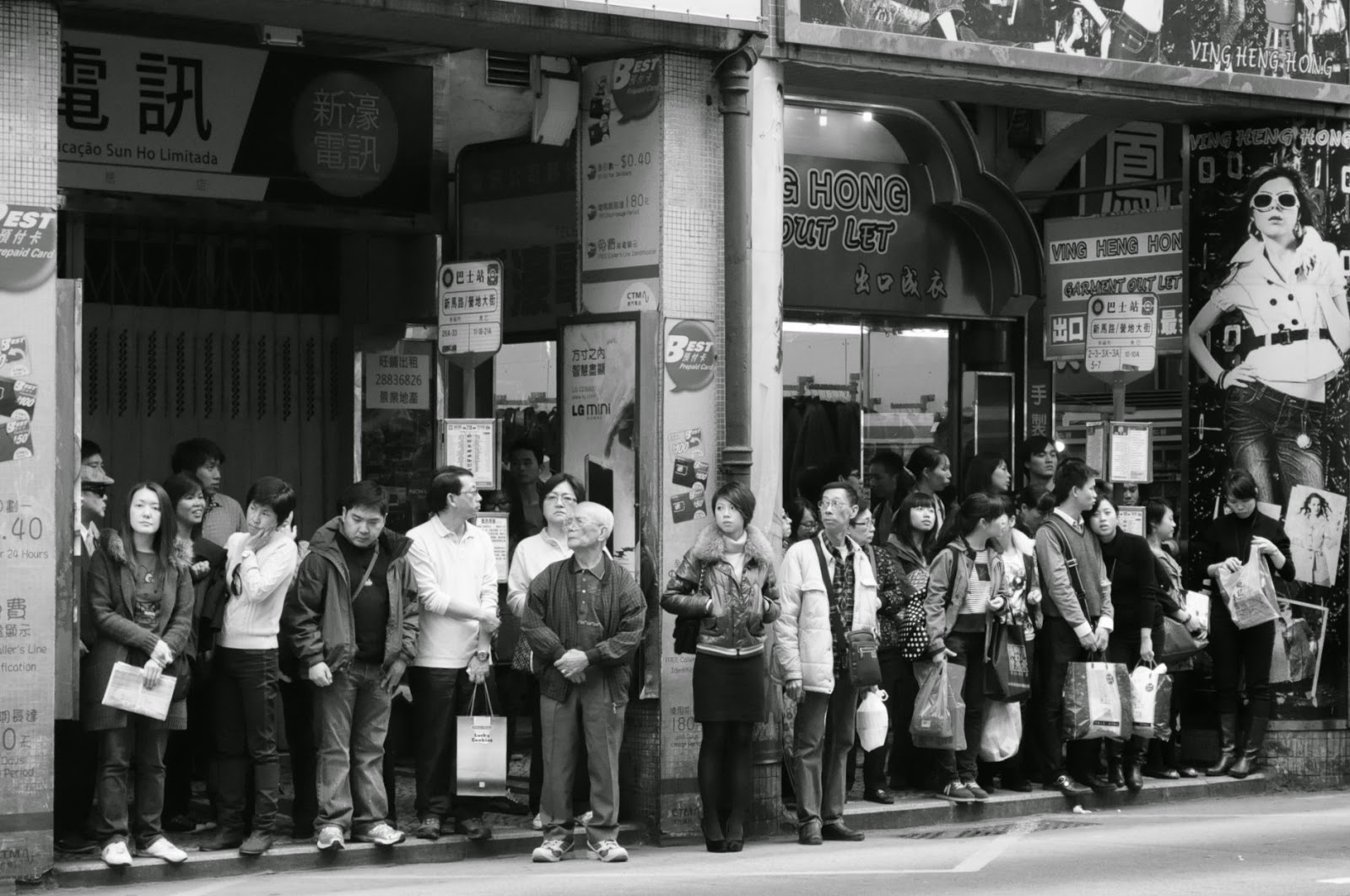
      I discovered street photography by accident.  I bought my first DSLR (a Nikon D5000) in Hong Kong in December 2010, and without knowing anything about a) how to use it or b) anything about photography at all, I just started shooting random tourist shots of things I liked, and on a trip to Macao produced a couple of images that really kick-started my interest in behaviour and moments in time in public situations:


      It was then during a conversation with my then TAOP tutor, where I mentioned that I just liked taking photos of situations in the street, that he recommended I get a copy of Street Photography Now, on which I posted a review in July 2012.  This was really the epiphany moment!  And it was from the revelation of this book that I got to know the work of many of the photographers whose work I now follow (some mentioned below).  After that, there followed two years of some unstructured experimenting and reading, until this summer, where in the quest to find my own style and meaning to photography, I decided to take some courses and workshops specifically in street photography (incidentally, I am still torn between street, travel and wildlife photography...and getting to the point where I think I just like to photograph "life" irrespective of genre....why does it need a label?).

      What is Street Photography?

      I have found over the past couple of years, that a much debated question is what exactly is street photography?  What does it mean?  What is the point of it?

      It seems to me that different people have different perspectives on street photography.

      An academic viewpoint is that expressed by Paul Halliday in Defining Street Photography, which is an all-encompassing all aspects of the narratives of the street.   And in fact, an awful lot of what I see on the internet and in publications described as street photography includes portraits, urban landscapes, travel scenes, and street scenes in general, as generally examined in Freeman, 2011 (see previous review).  However, and contrary to Halliday, I enjoy a different contemporary branch of street photography that focuses on the funny and the strange, as described below and which is consistent with the In-Public perspective on this, (bearing in mind that the boundaries with travel photography can be blurred as in Dakowicz (2011) Pillow - see below).

      In my own work I try to make a distinction between social documentary, portraiture, landscape and street photography - although all of these can of course be executed in the street and are recognisable as forming part of the broader street photography genre.  For instance, I would describe this photograph taken in July 2014 in Camden Town as a street portrait (albeit candid), rather than street photography:


      because, apart from the beautiful subject, light and colours, there is not a lot more to it.  But perhaps this photograph taken in Worthing in August 2014, which, although also a portrait, is more street photography because it tells a story and has a sense of irony (funny or sad depending on how you look at it) about the last days of summer (Last of the Summer Wine?):


      What I have gained from general reading, exhibitions, meeting other photographers and my participation in the In-Public workshop, is that firstly, street photography does not need to have been taken in a street.  For instance, Nils Jorgensen recreated the legend of the Underwater Gnomes of Wastwater (2011) in Cumbria reported by BBC News, although he was nowhere near a street at the time!

      Underwater Gnomes (c) by Nils Jorgensen
      Street photography also does not need to include animate objects, for example Matt Stuart's capture of an apparent peacock in New Bond Street (2006) (also features on the back cover of Street Photography Now):

      New Bond Street (c) by Matt Stuart
      In my view (formed by wider reading and attendance at workshops), and this is how I try to form my own practice, street photography is the manifestation and capture of one or more of the following events in a public context:
      • incongruence between two or more elements in the image, i.e. a situation that is absurd in its context, a twist, a strange juxtaposition
      • resonance between two or more elements in the image
      • something comical (but it has to be more than a person dressed in a funny costume....), i.e. interaction with a background
      • something comical that has a deeper social meaning
      • social commentary
      • something completely unexpected
      • irony / satire (akin to Far Side situations)
      • order out of chaos
      • extraordinary use of light
      • interplay of colour
      • portraits provided they are candid and tell a story or present the subject in a comical or other emotive, or cultural perspective
      • a situation made funny by the title and composition, as in Jorgensen (2011) Underwater Gnomes above (this particularly works well with dry humour or the art of understatement!).
      People always say that you should know why you are taking a photograph and be able to answer questions about what the point is of what your image?  I think that once you have established the boundaries of street photography described above, the answer to that is clear: to make people laugh or to support a social dialogue.

      I think of street photography as almost the photography equivalent to jazz music.  It has its own rules (i.e. it breaks the traditional rules of composition), its own rhythm, it own timing and its own direction.  The right-brained approach to its execution suits my spontaneous nature.  You can plan street photography as much as you like (i.e. locate a suitable background and wait for the right subject), but it is highly dependent on random events coming together in one scene or sequence.  Personally, I love that moment of panic when you realise that you have a situation in front of you and you've got to grab it then and there.  It's an adrenalin rush when it happens and even better if it works out!

      In the next sections, I'll look at a few of my favourite images by some of the contemporary photographers (listed in alphabetical order) that I find inspiring, and will comment on why the images are interesting and what the edge is that makes them street photography, rather than just a captured scene.

      Maciej Dakowicz

      Dakowicz is a now Mumbai-based reportage and street photographer.  He has previously lived in the UK in Cardiff, Wales, where he shot the images for his monograph Cardiff After Dark, a collection of 99 colour photographs depicting scenes shot in streets in Cardiff once the pubs had shut and the party had really begun.  At first glance, these photos are hilarious: funny people doing funny things after a "few too many".  The feat of this collection, and the commitment to its production, should not be under estimated: "...he photographed the same few streets in Cardiff on a Saturday night for five years" (O'Hagen in Dakowicz, 2012, p9).

      You can take these photos at face value (i.e. without social judgement) as just people having fun.  However, you could also read a deeper social commentary into this about the British way of life, our apparent obsession with alcohol over-consumption, and the lack of shame when we do it.  I however prefer to enjoy the former (as I know I've been there too!), the sheer hilarity of these situations.  Is Dakowicz taking advantage of people in compiling this work?  Are these photographs gratuitous?  I don't think so; a) its within his photographer's rights and b) in my mind, if you've put yourself in such a situation in public then fair game! I would describe this kind of street photography as fitting into the something comical that has a deeper social meaning theme mentioned above.  You could also describe it as reportage, as it belongs in a collection providing an insight into a situation.

      Picking out one photograph from this collection to illustrate the point is not easy.  They are all relevant, but I am still drawn to the very first one I saw when I originally looked at in Street Photography Now, and which had me in stitches (for the sense of normality and concentration in the subject's expression); it is published in Dakowicz, 2012, p39 and in Howarth et al, 2012 p32; the photograph was taken in 2006:

      Pink Hat (c) by Maciej Dakowicz
      There is however another side to Dakowicz's street photography and a significant portion of this kind of work has been shot in Asia.  And I think this is where the boundary between street and travel photography, and indeed reportage, become blurred.  One image that really demonstrates this for me is:

      Pillow (c) Maciej Dakowicz
      This is street photography, because it is a comical (although also slightly sad) image shot in a public place.  It contains a sense of irony (enhanced by the title).  You can read a social commentary/reportage into this i.e. about the stray dogs of India, and of course it is also travel photography because it's providing an insight into the way of life in another country.  I actually don't really care that it is any of the above.  I'm drawn to this as an emotive response as I have seen my own dogs put their heads in strange and uncomfortable looking places.  I also wish I'd taken it!

      Melanie Einzig

      Like most of the other contemporary street photographers I'm familiar with, I first came across New York-based Einzig through Howarth et al, 2012 pp 40-43, in which she is described (p40) as a "whimsical anthropologist".  Interesting that she says her best photographs are taken on the way to and from work; my brain is usually too broken to be able to do that, but I should try harder.  Einzig's photographs are bright and colourful, and the one I particularly like is shown on Howarth et al, 2012 p43 of a gentleman on the New York subway wearing yellow crochet doing his knitting.  Hilarious.  And I think, from my proposed themes above, this would fit into the category of something completely unexpected.  And of course, what really makes the photo is the fact that the other passengers on the train seem completely oblivious to the gentleman in yellow!

      Unfortunately, the only online source to this image that I can find is this one: http://pikdit.com/i/he-didnt-choose-the-knitting-game-the-knitting-game-chose-him/ [accessed 25 August 2014].

      David Gibson

      I met London-based Gibson at the In-Public workshop mentioned above.   Like many of the other contemporary street photographers mentioned in this post, Gibson also captures absurd situations and visual puns.  I particularly like this image of some children waiting in the street by the No Parking sign taken in 2008, featured in Howarth et al, 2012 p52 and in Gibson, 2014 p53.  It's funny, the subjects are interacting with the background in an incongruous way, and there is also resonance in the gestures and expressions of the children.   In addition, Gibson has brought some order into a potentially chaotic situation: 

      London (c) David Gibson
      Another example of Gibson's work, where the subject is interacting with the background, can be seen in this image from Gibson, 2014, p87 taken in 2010 of a woman who looks as if she is about to propel herself from the mattresses; this reminds me of the position static line parachute jumpers have to assume in order to launch themselves from the plane doorway:

      London (c) David Gibson
      Gibson's other styles go beyond my interpretations of street photography into the realms of abstract imagery, as featured in Gibson, 2014, pp 116-117 and 126-129.  And on the workshop I learnt from him about looking for abstract shapes, gestures and pattern repetitions within street scenes.  Although this is not a direction I particularly want to go in at the moment (I prefer the comedy situations!),  I have ventured down this route in the past and I am not dismissing it as a future option either.

      Nils Jorgensen

      I also met London-based Jorgensen on the In-Public workshop.  Jorgensen's style is to capture absurd and comical moments, but his approach is quite different.  For a start he carries a professional camera (rather than trying to remain hidden and inconspicuous) and he also favours a frenetic approach (rather than stealth) to riding the London underground and capturing the comedy to be found below.  Gibson descibes him as "tenacious" and some who "takes photographs on the way to taking photographs" (Gibson, 2014 p 90).  I particularly like this image, taken in 2006, again interaction between foreground and background, which looks as if there is a line of heads peering out over the woman reading the newspaper (similar to people reading over your shoulder on the tube!) :

      Tight Squeeze (c) Nils Jorgensen
      Dave Mason

      I got to know London-based Mason's work through my first ever street photography workshop I participated in held by him in Greenwich in November 2012.  Aspects I really like about Mason's work include his ability to capture funny events while no one else in the scene is paying any attention at all, (extraordinary within the ordinary) and also the layering (as does Dakowicz and Wallace also) that he introduces into the frames.  I've seen three photographs by Mason quite recently that have really grabbed my attention (read three among many!): "There's never a number 11 when you want one" and "Refurbishment", both shot in 2014, and "Greenwich" shot in 2012 (during my workshop :) ). 

      There's never a number 11 when you want one (c) Dave Mason
      I particularly like this image because of the layering of the different subjects, but also because of the comedy of the person reading the bus time-table without realising what's going on behind him.

      Refurbishment (c) Dave Mason
      In this image, the comedy is derived from the title referring to juxtaposition of the person and the building.  In this, and the image above, Mason has found a funny situation (he actually found lots!) in an event, whereas my photographs from both the 2014 London Naked Bike Ride and the Pride festival were of a more journalistic style, so I was able to learn from these examples.

      Greenwich (c) Dave Mason
      This image is another example of interaction between subject and background.  Mason has humorously arranged the scene to make it appear as if the display is actually part of the queue.  

      Shin Noguchi

      Based in Kamakura and Tokyo, Japan, Noguchi's style is quite different to the other photographers mentioned in this post.  Noguchi also aims to capture life's extraordinary moments, but in his images, he also injects beauty and grace.   In his project, "Sorry, you'll never walk alone", he looks at contradictions between human nature and what he refers to as the "essence of society"; this project documents the inability of humans to walk without carrying something in their hands.

      Some of his images remind me of Far Side scenes - the extraordinary element is sometimes quite subtle - and you are faced with an intellectual challenge to work it out! With Noguchi, I know that if I haven't got it the first time, I need to look harder, as the sense of irony is definitely there.

      But in addition to the contradictions, Noguchi also captures an extraordinary use of light with high contrast and spotlight on the subject, for instance in this image of a gentleman carrying his dog wearing a winter jacket in the streets of Kamakura 2012.

      Komachi, Kamakura 2011 (c) Shin Noguchi
      When you view the "Sorry, you'll never walk alone" series as a collection, you really appreciate the benefit of executing street photography on the basis of a theme; the images really hold well together and from one to another.

      Another of Noguchi's images that I have noted recently is this one from his Colour 50: Something Here series taken in 2011 in Guam, showing a child carrying a pool inflatable walking into a room with suspended window cleaners looking through.  This is an example of the juxtaposition that is inexplicable (although may also be a commentary on the US territory of Guam that I'm not aware of ?):
      Tumon, Guam 2011 (c) Shin Noguchi
      Finally, on the subject of contrast (colours), resonance (chameleon tail shapes), this image taken in 2014 by Noguchi is a great example that poses almost confusion and leaves you thinking; it's hard to see where the check layers actually lie.

      Ginza, Tokyo 2014 (c) Shin Noguchi
      David Solomons

      London-based Solomons is the third photographer I had the privilege of working with on the In-Public workshop and is another photographer whose work I think is sometimes also quite "Far Side".  Solomons is also a photographer who works in terms of projects, this one below (which I would put into the funny and absurd themes from above) is from "Forty Winks":

      Leyton (c) David Solomons
      Another image by Solomons that also stands out in the funny / incongruous category is this one taken in 2009 from the "Up West" project showing great contrast between Tesco and Reiss, and the bored (assume) husband dragged along shopping for ladies clothes:

      Oxford Street (c) David Solomons
      Matt Stuart

      I think London-based Stuart (also a tutor on the In-Public workshop) was probably the first exposure I had to street photography, as his 2007 image Trafalgar Square graces the front cover of Street Photography Now (and is also included in Seaborne et al, 2011 p110), and which I believe has sparked a trend in photographing pigeons amongst Stuart devotees:

      Trafalgar Square (c) Matt Stuart
      This image illustrates the point made above about resonance (legs), plus also appears absurd and disproportionate.  It also introduces the concept of framing, with legs being framed within legs.  It's also funny that the pigeon is leading....

      However, there is another photograph by Stuart that I also like taken in Aldersgate Street (date not known):

      Aldersgate Street (c) Matt Stuart
      And that's most likely because of the dog - but also the clever framing to make it appear that the dog is in the driving seat!  Finally, I think that for Stuart, it's worth mentioning his shots showing interaction with backgrounds with the comical High Holborn (date not known):

      High Holborn (c) Matt Stuart
      Many of Stuart's images contain themes of resonance, apparent absurdities and interactions with backgrounds as illustrated above.

      Dougie Wallace

      Last but not least, a photographer that has recently come into my world is London-based Wallace (aka "Glasweegee").  I first came across Wallace earlier this summer when I attended the launch party for his book Stags, Hens and Bunnies.   Very similar style to Cardiff After Dark (and a response to?), however I think Wallace takes this to another level of what can only be described as British behaviour.....  As with Cardiff After Dark, I think these images fall into the theme of comedy (hilarious) but with a deeper social message.  Set in Blackpool, England, in this case, the social message is not just about the excessive consumption and outrageous behaviour, it is also about the tension Blackpool faces every weekend: "hen night central or historic family seaside resort?  It can't be both" (Wallace, 2014, p9).  This is as much about the economic tension, as anything else: would Blackpool survive if you took away the night-time economy?

      So what of the photos?  There are simply crazy; no other words to describe them.  Here is just one relatively tame example displayed in Wallace, 2014, p17, with wonderful contrast between pink and yellow, but as with Dakowicz 2012, you just have to see the book to get the full impact:

      All the Fun of the Fair (c) Dougie Wallace
      Conclusion

      The contemporary photographers presented here show a cross-selection of themes based on my analysis above.  I have selected individual photographs and these have been shown out of context to illustrate specific points, but in context you see that all these photographers do in fact make use of all the themes I described above in different situations.  What remains to be seen now is whether I can put it into practice for the exercise!


      Research Point Questions
      • What difference does colour make to a genre that traditionally was predominantly black and white?  The only black and white image I looked at above for my research was Greenwich by Mason.  I'm guessing he excluded colour to reduce distraction and to make the figure in the display blend into the queue more easily.  On the whole, I prefer colour street photography, and I think that most of the work I've shown here is dependent on colour, especially work by Stuart, Wallace and Dakowicz.  Wallace's work in particular has the same colour/light feel about it as that of the seaside photos of Martin Parr (see website).   Trafalgar Square by Stuart is almost monochromatic, but the pink of the pigeon legs really make those legs stand out!  I find that black and white in street photography adds a timeless and almost documentary/journalistic feel; it makes it seem more informative, as seen in various images in Seaborne et al, 2011.  Colour adds a more contemporary, brighter, modern feel to the image.  For instance in Seaborne et al, 2011, p96, there is a photograph of a homeless person sleeping rough.  The image is dated 1997 so many decades after when colour photography became popular, and although the subject is juxtaposed against a background in an interactive way, the image still appears more documentary than it would have done had it been produced in colour.
      • Can you spot the shift away from the influence of surrealism (as in Cartier-Bresson's work)?  To be honest, no I can't!  I think the work illustrated here borders on surrealism - it's just a more modern interpretation, and I think more surreal than Cartier-Bresson.  For example, the selective framing of Leyton by Solomons, London (2010) by Gibson, Tumon, Guam by Noguchi, and Aldersgate Street by Stuart, are all quite surreal.  I think the shift over time has been away from a documentary style, e.g. as represented in Delaney et all, 2012, and more towards this style of comedy, irony, incongruence and surrealism.
      • How is irony used to comment on British-ness or American values?  I think Pink Hat by Dakowicz and All the Fun of the Fair by Wallace are great examples of this.  From these images an outsider would suppose that the British value this kind of behaviour and promote an excessive culture of consumption, and that that is normal.  Another example is Refurbishment by Mason; we value freedom of speech, behaviour and to be yourself without suffering prejudice, yet here Mason has presented a scene that is ironic as a result of the juxtaposition.
      Exercise

      This research was all in aid of preparation for an exercise on street photography (course notes page 33).  We are required to take 30 colour and 30 black and white photographs in ONE street.  I would consider myself lucky if I got 60 good street photography type images (according to my interpretations) in a whole life time, so 60 in one street is a tall order....... Clearly the OCA has a broader view of street photography than I do.....

      One aspect of street photography that I really like is English seaside images, which I haven't really covered much above.  I think you see some great street photography moments in England's seaside resorts.  For instance Barry Island by Solomons taken in 1994:

      Barry Island (c) David Solomons
      and the Lladudno series by Parr

      [24 August] So I think for my street, I'm going to have a go at the street that runs alongside the seafront in Worthing on 25 August (fun fair, food festival, pier) - called various names in different places, but I will walk the length of the seafront along Worthing using my themes defined above, but incorporating a documentary / satirical style of seaside portraits inspired by Parr.  I don't know yet how I'll tackle the black and white - I'll work that out later.  I can always go back another day to finish it off.

      [25 August] Plan thwarted by amber rain alert... not the kind of rain that blows over and is followed by bright colours against beautiful dark skies and amazing clarity - but non-stop torrential rain.  No point in going to Worthing as a) my camera will get drenched and possibly damaged, but b) people are unlikely to be outside.  Strong risk of getting there to find an empty promenade!  Back to the drawing board.  Other options include my original plan of Bond Street (New and Old together) as it has excellent backdrops, tourists, and so on, or I can try to get back to the seaside during September if the weather improves.....

      [13 September] In the end I went to Brighton for a day of seafront people shots.  Not quite consistent with my "In-Public" definitions, but a documentary nevertheless of Brighton's residents!  See street photography exercise also for Project Three.


      Photographers mentioned websites:
      References:
      • Dakowicz, M. (2012) Cardiff After Dark, London: Thames & Hudson, p39
      • Delaney, H. and Baker, S. (2012), Another London, London: Tate Publishing 
      • Freeman, M. (2013) Michael Freeman's photo school street, Lewes: ILEX 
      • Gibson, D. (2014) The Street Photographer's Manual, London: Thames & Hudson p53 and 87
      • Howarth, S. and McLaren, S. (2011) Street Photography Now, London: Thames & Hudson, front and back covers, p32, p40-43
      • O' Hagan, S in Dakowicz, M. (2012) Cardiff After Dark, London: Thames & Hudson, p9
      • Seaborne, M and Sparahm, A. (2011) London Street Photography 1860-2010, Stockport: Dewi Lewis Publishing, p110
      • Wallace, D. (2014) Stags, Hens and Bunnies, Stockport: Dewi Lewis Media, p9
      Websites:

      Source Websites for images uploaded: