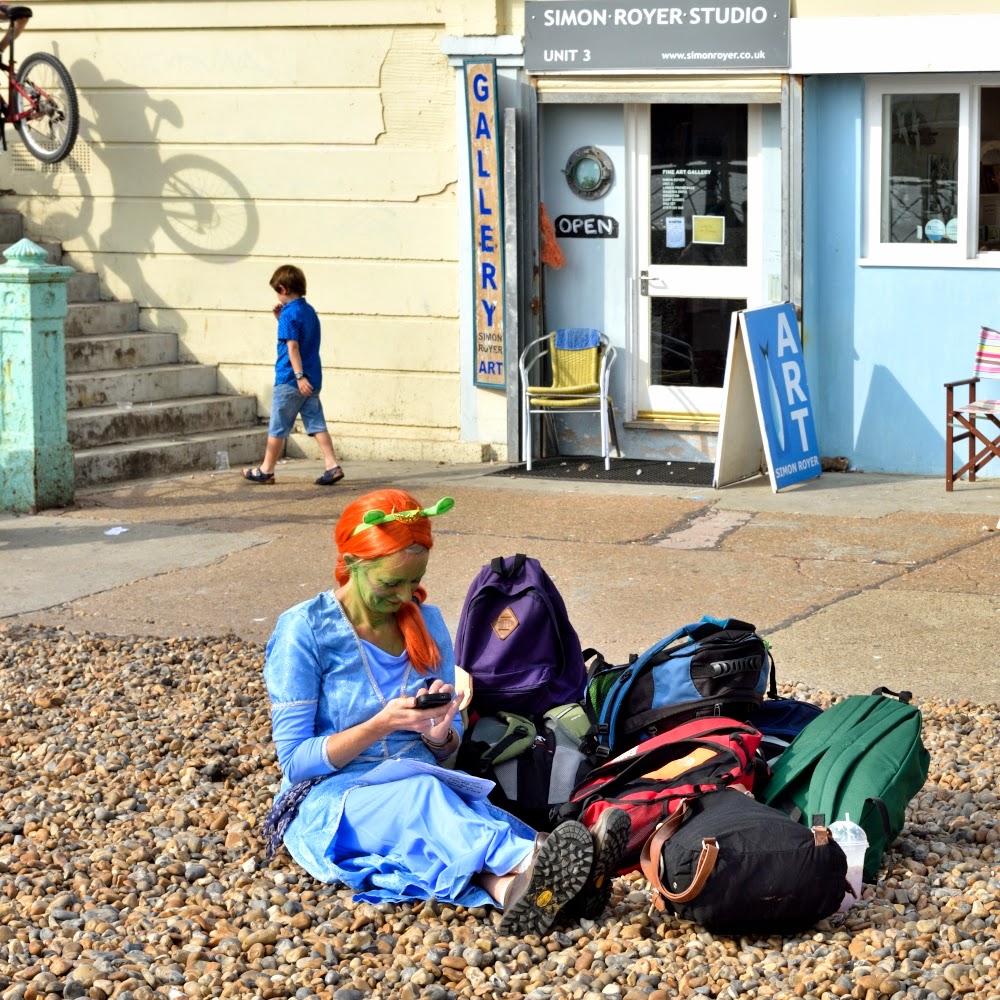
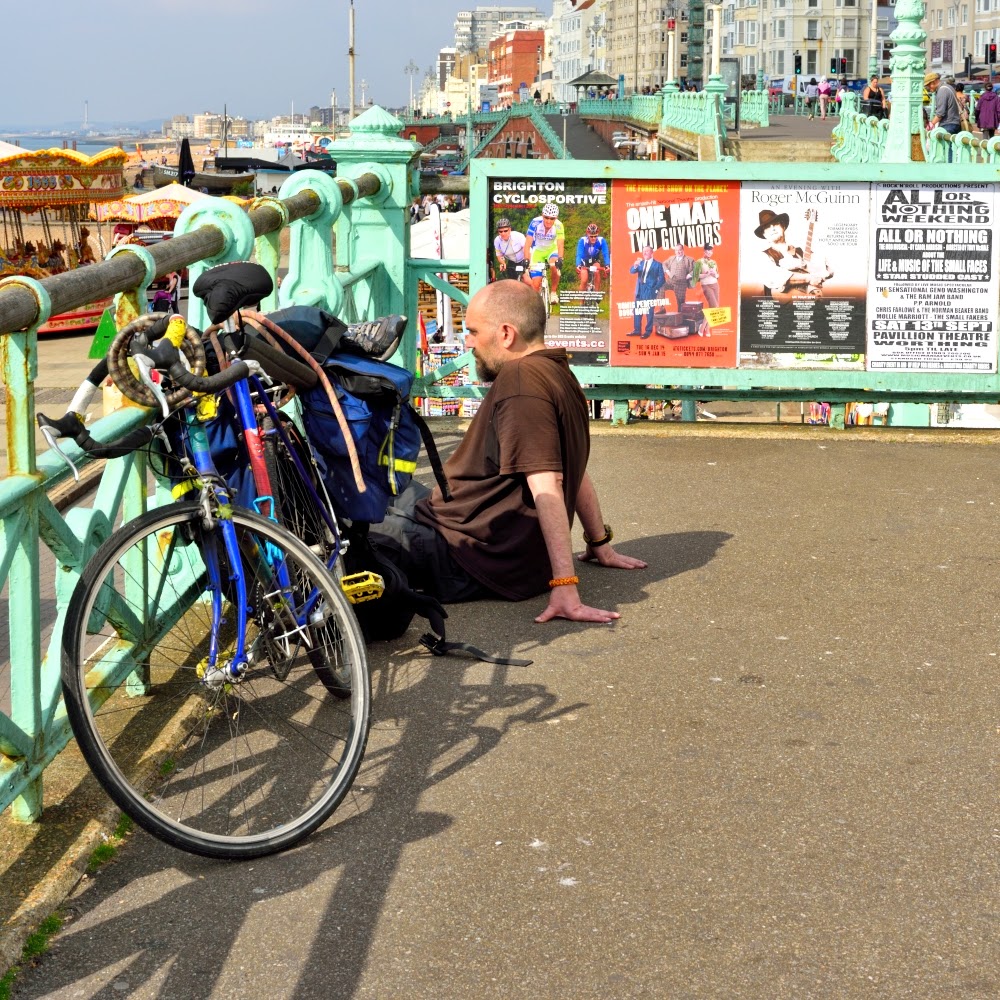
The article in question is written by Anita Strasser, who is a fellow member of Crossing Lines, and is studying for her MA in Photography and Urban Cultures at Goldsmiths University of London. In 2013, Strasser wrote an assignment paper entitled Re-re-conceptualising Street Photography:towards a more reflexive definition, which included an account of her own experience in entering a street photography competition with restrictions on non-candid images.
Strasser argues in her reasoned and thought-provoking paper that due to the popularity and impact of the In-Public style of Street Photography, the genre has moved away from the traditional role of documenting social and historical contexts in the street and towards the representation of the "funny and bizarre" using a shoot and run approach that I stated as my Street Photography practice in my previous post. She further makes the point that the now current exclusion of the traditional approaches and purposes of Street Photography has no purpose and also undermines the real value of Street Photography in opening social debate. Strasser reinforces the point with the example of the Museum of London exhibition and book in 2011 of Street Photography from 1860-2010 (see previous post), which excluded the work of Markéta Luskačová (to be reviewed in a later post).
Strasser is of course right in her views. Street Photography in the traditional sense has played a significant role in documenting social, economic, and "providing historical insights into cities and peoples" and it absolutely must continue to do so. There is clearly a place and purpose for this kind of photography, and what street photographers are capturing now will be of significant interest to people in the future; there is no denying this.
In In-Public's defence, and these observations are anecdotal from my experience of attending their workshop (I have not sought to validate them with references):
- There is very little, if any, commercial gain in their type of photography. Yes a few of them have published books and hosted workshops, but this is not how they earn a living. They all have real jobs, either in photography, or in some other field. And in fact, Matt Stuart told me that the workshops are mostly loss-making.
- They do not profess to be offering any social, political or historical value, or in fact any significant purpose at all.
- At the In-Public workshop I attended, we covered the history of Street Photography as each photographer spoke about their influences.
- The objectives of this type of photography are not to ridicule or humiliate people but to capture random events that manifest together in a frame usually to provide a resonance or contrast, in such a way that an unique and spontaneous scene presents. If the outcome is comical, that is a bonus. When you engage with a subject, and move from candid to non-candid, that unique moment is lost.
- The final image is a truth - at that moment in time. Of course it's heavily influenced by the angle, framing, perspective etc, but isn't that true of all photography? Aren't all photographic images representations of what the photographer saw and excluded during that moment in time?
- And what of another In-Public photographer, Maciej Dakowicz? His work is sometimes engaged, sometimes candid, sometimes about the random events but not always, has strong travel/documentary/reportage themes, and can be serious and funny.
- This type of photography is extremely hard. It takes a certain kind of thought process, lightening speed reactions, and extreme dexterity to make it work.
So what is the answer? The conclusion of Strasser's essay is a call to redefine Street Photography. If that was the case, would we have two new categories: street documentary and street random manifestations? And what about street travel? A lot of street photography to me also looks like travel photography, e.g. in APF (because it is an international magazine and I see it from an English point of view), and I consider this also to be in a documentary style rather than In-Public style. There is also a similar boundary, although perhaps more obvious, between nature and wildlife photography: the former accepting and the latter excluding captive animals; but surely both can provide pleasing studies of animals and both are acceptable in the right conditions?
I am actually not sure what is required, as there is sufficient work around Street Photography that does not include the In-Public definition, to make me believe that not everyone considers that this is the be all and end all of Street Photography. For instance, on the LSP course I attended (see July and August posts), the In-Public style was not mentioned once during the eight days, and nor was it mentioned in the Michael Freeman book I reviewed. In fact, I really wonder why we need genres, labels and so on. Part of the problem I have is that in searching for a path to follow, it seems that I should be expected to drop other interests. Why do I have to chose between wildlife, travel, street (In-Public style) and more conceptual work (e.g. for OCA assignments)? I enjoy them all. Why do I need to be labelled? Surely I am documenting life in a variety of situations?
Whilst I strongly sympathise with Strasser, and I think in her shoes I would have had the same reaction, in my view, what is important is that boundaries or requirements for competitions, exhibitions, pieces of work are clearly defined, so that entrants and audience alike understand what they are in for, i.e. it must be made very clear, so that there can be no doubt, whether the work in question relates to engaged documentary or to candid observational photography. At the end of the day, Street Photography is such a broad topic that some refinement is needed to define the precise purpose of a body of work be it to engage in social reflection or quite simply to provide some light entertainment.
References:
- Strasser, A. (2013) Re-re-conceptualising Street Photography: towards a more reflexive definition [online] available from https://www.academia.edu/7931001/Re-re-conceptualising_Street_Photography_towards_a_more_reflexive_definition [accessed 4 October 2014]
- Art Photo Feature Magazine available from http://www.artphotofeature.com/#sthash.uychs4cB.dpbs [accessed 4 October 2014]
- Crossing Lines available from http://www.gold.ac.uk/cucr/vurbanism/crossing%20lines/ [accessed 4 October 2014]
- Goldsmiths University of London available from http://www.gold.ac.uk/ [accessed 4 October 2014]
- Maciej Dakowicz available from http://www.maciejdakowicz.com/ [accessed 4 October 2014]
- Markéta Luskačová availble from http://www.marketaluskacova.com/home [accessed 4 October 2014]
- Adcock, A. (2012) London Street Photography 1860-2010 by Mike Seaborne and Anna Sparham. TAOP Blog [available online] http://jointheaa-taop.blogspot.co.uk/2012/08/london-street-photography-1860-2010-by.html [accessed 4 October 2014]